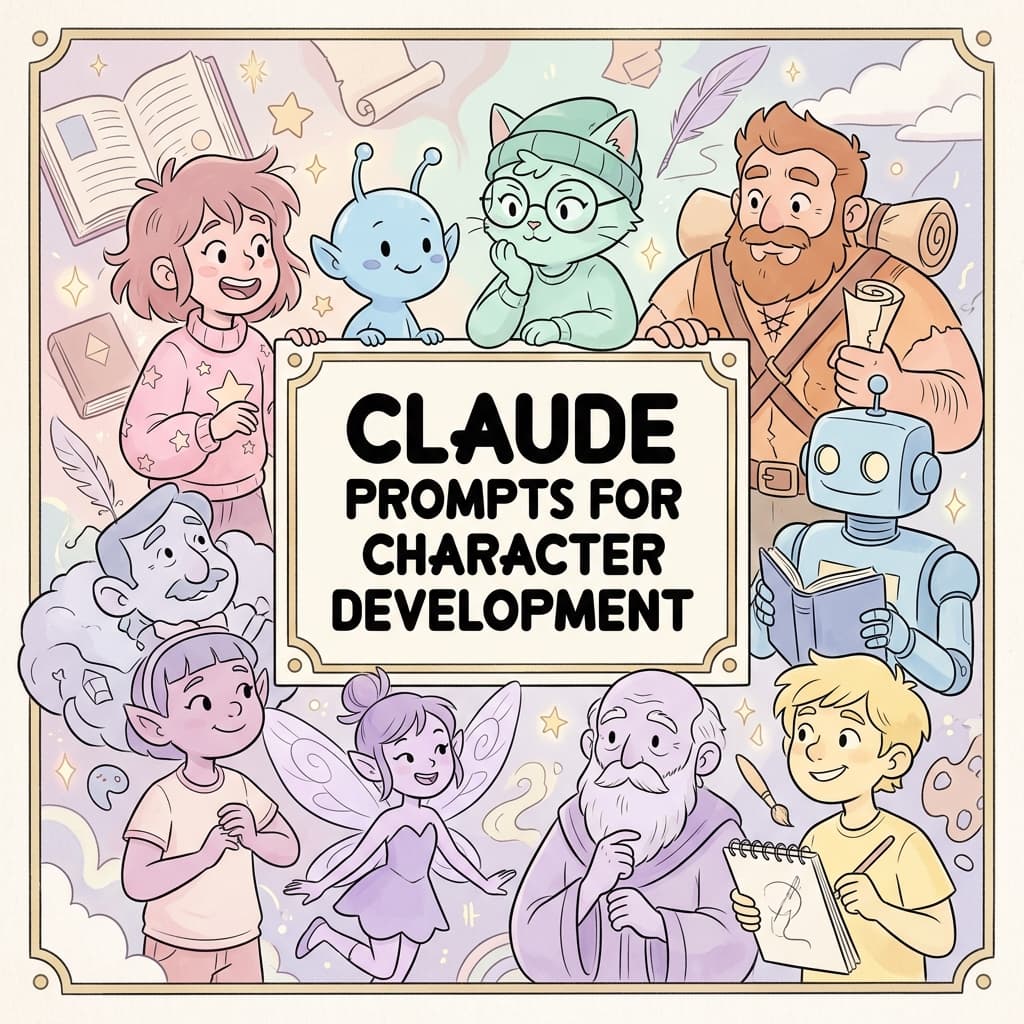
How to use Claude Prompts for Character Development that actually work in 2026
A 7-step process for Claude prompts that build characters with real depth — not another copy-paste list. Contradiction-first traits, backstory from a present wound, dialogue stress-tests, and consistency guardrails.
How to Use Claude Prompts for Character Development That Actually Work
Most character-building prompts fail for the same reason: they ask Claude to invent a personality from nothing. "Give me a character for my fantasy novel" produces exactly what you'd expect — a competent, forgettable person with a sword and a tragic backstory that reads like a hundred others. The problem isn't the model. It's that character depth doesn't come from a single request. It comes from a process, the same way it does when a human writer builds a character over several drafts.
The short version: don't ask Claude for traits, ask for a contradiction. Build backstory backward from a present-day wound instead of a timeline. Test the character in dialogue before trusting the description. Use a multi-step "interrogation" instead of one request. Add consistency guardrails for long projects. Structure longer prompts into labeled sections. And once a character exists, ask Claude to stress-test them the way an editor would.
This guide walks through that process — the prompt patterns that get Claude to produce characters with a real arc and real motivation, and a few techniques most "list of prompts" articles skip entirely.
Start With Contradiction, Not Traits
The fastest way to get a flat character out of Claude is to ask for a list of traits: brave, loyal, quick-tempered. Traits alone describe a character sheet, not a person. Real characters feel real because they contradict themselves — the brave one is also afraid of something small and specific, the loyal one has one line they won't cross even for people they love. This is also where a character's motivation starts to take shape — a clean, single-note trait rarely gives a character something to actually want.
✗ Give me a brave, loyal character for my fantasy novel.

✓ Give me a character built around a contradiction: someone who is
  brave in physical danger but conflict-avoidant in every personal
  relationship. Explain where the contradiction comes from and one
  situation where it would cause them real trouble.
The first prompt does two things a trait-list prompt doesn't. It forces Claude to reason about cause and effect instead of just generating adjectives, and it hands you a built-in source of future conflict — which is exactly what a character needs to carry a story, whether they're your protagonist or a foil standing opposite them.
Build Backstory Backwards, From the Wound
Backstory prompts often go wrong by asking for a timeline: birth, childhood, family, the works. Claude will happily generate one, but timelines rarely produce anything usable — they read like a Wikipedia summary of a person who doesn't exist.
✗ Give me this character's full backstory from birth to present day.

✓ This character struggles with trusting authority figures in the
  present day. Generate three different backstory events that could
  explain this, each from a different stage of their life, and tell
  me which one creates the richest opportunities for scenes later in
  the story.
Notice the second prompt asks Claude to evaluate its own suggestions for story usefulness, not just plausibility. That single addition turns a backstory generator into a collaborator that's actually thinking about your character's arc, not just their biography.
Use Dialogue to Test a Character, Not Just Describe One
A character description can sound compelling on paper and still fall apart the moment they open their mouth. This is where a lot of AI-assisted character work quietly breaks down — the character's voice in dialogue doesn't match the personality described earlier in the conversation. This is really just the "show, don't tell" principle applied to prompting: a paragraph telling you a character is guarded proves nothing until you watch them actually deflect a question.
✗ Describe how this character behaves when they don't trust someone.

✓ Write a two-person conversation where this character is trying to
  avoid answering a direct question from someone they don't fully
  trust. Don't have them lie outright — show how they deflect.
Reading a character under a small amount of pressure tells you more in six lines of dialogue than three paragraphs of description ever will. If the voice feels generic, that's useful information — it means the character needs a sharper contradiction, not more backstory.
Give Claude a Job, Not Just a Prompt: The Interrogation Technique
One pattern that consistently produces better results than a single request is treating Claude like a co-writer you can interrogate. Instead of asking for a finished character in one shot, build them through a short back-and-forth.
✗ Give me a fully detailed character for my heist story, including
  personality, backstory, and motivation.

✓ 1. Give me a rough concept for a character who plans the heists but
     never joins them.
  2. What does this character want, and what do they actually need,
     if those two things are different?
  3. What's the one thing this character would never admit, even to
     themselves?
  4. How does that hidden thing leak out in small, indirect ways?
The single mega-prompt on the left tends to produce a character that sounds complete but plays generic. The four-step version on the right sharpens with each answer — by the fourth question, you typically have something with real psychological weight, not because Claude suddenly got smarter, but because you gave it room to build in layers. This is, in effect, how you sketch a character arc in miniature: want, need, and the gap between them is the engine most arcs run on.
Set Guardrails So Claude Doesn't Drift From Your Story
A detail that rarely shows up in prompt roundups but matters a lot in practice: Claude, like any model, will sometimes wander — introducing new plot points or personality shifts you didn't ask for, especially over a longer conversation.
✗ [Later in a long conversation] Now write a scene where this
  character confronts their sister.
  (Claude may quietly invent a sister who was never established.)

✓ Keep this character consistent with what we've already established:
  [quick summary]. Don't introduce new backstory elements — like new
  family members or past events — unless I ask for them. Now write a
  scene where this character confronts their sister, [name],
  established earlier as [detail].
This one instruction saves a surprising amount of cleanup work later. Writers who skip it often find themselves reconciling three slightly different versions of the same character by the time they reach chapter ten.
Structure Longer Prompts With Clear Sections
If you're building a full character profile in one go — physical description, personality, backstory, relationships, arc — a wall-of-text prompt makes it easy for Claude to lose track of one section while focusing on another.
✗ Tell me everything about this character — what they look like,
  their personality, their backstory, their relationships, and how
  they change over the story.

✓ Give me a character profile with these sections: Core Contradiction,
  Want vs. Need, Formative Event, Speech Pattern, and Relationship to
  the Protagonist. Keep each section to 2-3 sentences.
The labeled version effectively becomes the start of a character bible you can keep building on. Short, labeled sections also make the output easier to actually use — you can drop each piece into your outline or character bible without editing a dense paragraph down first.
Revise Characters the Way You'd Revise Prose
Character prompts shouldn't stop at generation. Once you have a character on the page, ask Claude to stress-test them.
✗ Does this character work well for the story? [pasting the full
  character profile]

✓ Look at this character and tell me where they feel inconsistent or
  convenient — moments where their actions serve the plot more than
  their own personality.
The first question invites a generic "yes, this works well" response. The second gives Claude a specific job — hunting for seams — and catches the thing writers often miss on their own: a character who conveniently knows the right skill at the right moment, or who forgives too easily because the story needs them to. This mirrors standard craft advice on character consistency — the same checks an editor would run on a manuscript, just available on demand at the drafting stage.
Frequently Asked Questions
How do I use Claude to build a character from scratch? Start with a contradiction rather than a list of traits, then work backward from a present-day struggle to find a backstory event that explains it. Test the result in a short dialogue exchange before treating the character as finished.
Can Claude write fanfiction or characters based on existing IP? Claude can help with original characters and general character-building techniques, but avoid asking it to write scenes featuring copyrighted characters verbatim or in ways that closely mirror a specific published work.
What's the difference between a character's want and their need? The want is what the character consciously pursues; the need is what would actually resolve their internal conflict, and the two often point in different directions. That gap is frequently what drives a character's arc across a story.
How many prompts does it take to develop a full character? There's no fixed number, but a short back-and-forth of four or five targeted questions — concept, want vs. need, hidden truth, how it leaks out — usually produces more depth than one long, detailed request.
Related
Resources
ChatGPT Professional Photo Prompt: 15 Studio-Quality Templates (2026)

AI Halloween Photo: Prompts That Actually Look Like You (2026)

AI Christmas Photo: The Viral Prompt + How to Actually Do It (2026)

AI Prompt for Instagram Post: Formula + Templates (2026)