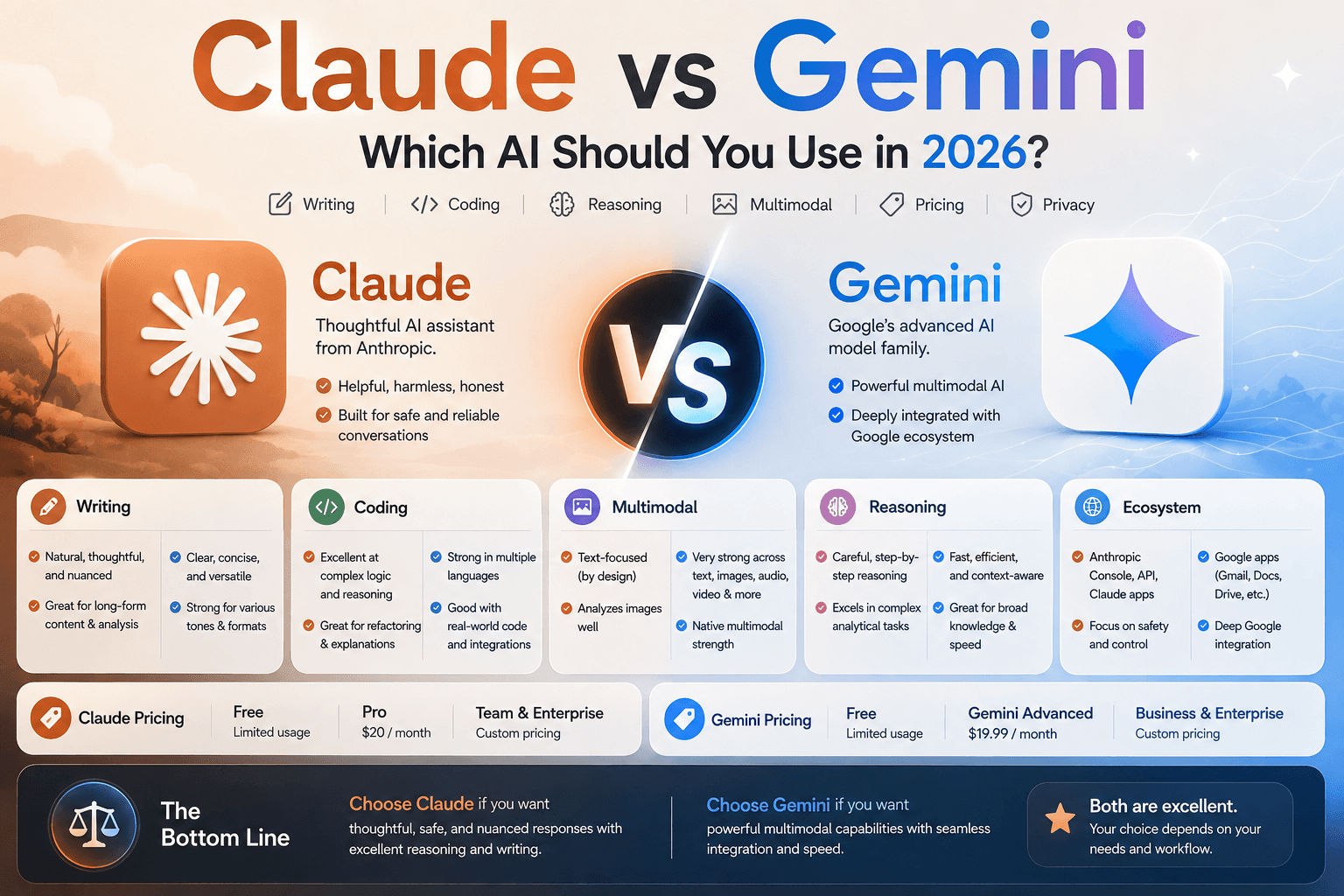
Claude vs Gemini: Which AI Should You Use in 2026?
Claude vs Gemini compared for coding, accuracy, research, context window, and pricing — plus real hands-on experience and answers to the most-asked questions about both.
Claude vs Gemini 2026: Which AI Model Is Actually Better?
Quick Answer
As of August 2026, Claude leads on coding, agentic tasks, and independent reasoning benchmarks — Claude Opus 5 currently tops Artificial Analysis's Intelligence and Agentic indexes. Gemini leads on native multimodal generation (images and video in the same chat) and Google Workspace integration, though its next flagship, Gemini 3.5 Pro, has been delayed three times and still hasn't shipped. Choose Claude for coding, writing, and multi-step reasoning. Choose Gemini if you live in Gmail/Docs/Sheets or need built-in image and video generation.
What's New Right Now (August 2026)
Both companies have moved fast in the last few weeks, and the picture looks different than it did even a month ago:
- Anthropic shipped four new models in about seven weeks: Claude Sonnet 5 (June 30), Claude Fable 5 and Claude Mythos 5 (June 9, Anthropic's new top-tier "Mythos" class), and Claude Opus 5 (July 24), which replaced Opus 4.8 as the default model on Claude Max and the strongest model available on Claude Pro.
- Fable 5 and Mythos 5 were briefly pulled from international access. On June 12, 2026, Anthropic suspended both models to comply with a U.S. Department of Commerce export-control directive; the Department lifted the controls on June 30, and Anthropic restored access on July 1. Details are in Anthropic's official statement at anthropic.com/news/fable-mythos-access.
- Google has shipped three new Flash-tier models but no new Pro-tier flagship. Gemini 3.6 Flash, 3.5 Flash-Lite, and a restricted 3.5 Flash Cyber (limited to governments and trusted partners) all launched in late July. Meanwhile Gemini 3.5 Pro — announced back in May with a "next month" promise — missed its June target, its July 17 target, and its July 31 target. As of this writing, Google still hasn't published an official launch, though unconfirmed sightings on the Arena testing leaderboard in early August suggest a release could land any day.
- Practical effect: today's Gemini flagship for serious reasoning work is still Gemini 3.1 Pro, a model that launched in February 2026 and hasn't been updated since — a five-month gap that stands out against Anthropic's release pace and Google's own Flash-tier cadence.
Given how quickly this is moving, treat the model names below as an August 2026 snapshot and check each company's official pricing/model page before you commit to a plan.
What Is Claude? (Full Current Lineup)
Claude is Anthropic's model family, built around reasoning quality, coding, and safety. As of August 2026, the lineup has four public tiers:
- Claude Haiku 4.5 — the fast, low-cost model for high-volume or latency-sensitive tasks.
- Claude Sonnet 5 (June 30, 2026) — the balanced default most users interact with day to day, with a 1M-token context window.
- Claude Opus 5 (July 24, 2026) — the current flagship for serious reasoning and coding work. Anthropic positions it as approaching the capability of Fable 5 at roughly half the API price, with a toggle for reasoning effort (low/medium/high) so users can trade cost against depth. It's the default model on Claude Max and the strongest model available on Claude Pro.
- Claude Fable 5 (June 9, 2026) — Anthropic's most capable widely-released model, sitting in a new tier above Opus called "Mythos." It runs with always-on adaptive thinking, a 1M-token context window, and built-in safety classifiers that automatically route flagged requests (in domains like cybersecurity and biology) to Opus 4.8 instead. A sibling model, Claude Mythos 5, shares the same underlying capability without those classifiers but remains restricted to a small number of vetted organizations through Anthropic's Project Glasswing — it isn't available to the general public.
Claude's two defining tools are Claude Code, an agentic coding assistant that can plan, edit, and test changes across a codebase with minimal supervision, and Projects/Artifacts, for organizing longer-running work like reports and reusable prompts. Claude does not natively generate images or video — it's a text-and-document-first assistant, extendable through Model Context Protocol (MCP) connectors to tools like Google Drive, Slack, and GitHub.
Claude is a good fit for:
- Developers who want an agentic coding assistant, not just autocomplete
- Writers, editors, and analysts doing text-heavy professional work
- Teams that need long, multi-step reasoning over documents and tool output
- Anyone prioritizing output quality over raw feature breadth
What Is Gemini? (Full Current Lineup)
Gemini is Google DeepMind's model family, built around native multimodality — one model handling text, images, video, and audio without switching tools. As of August 2026, the shipping lineup looks like this:
- Gemini 3.5 Flash-Lite — the cheapest, highest-throughput tier, built for large-scale automation.
- Gemini 3.6 Flash (late July 2026) — the current "workhorse" model, positioned as more token-efficient than its predecessor while improving coding and multimodal performance.
- Gemini 3.5 Flash Cyber — a cybersecurity-tuned model, available only to governments and select partners in a limited pilot.
- Gemini 3.1 Pro (February 19, 2026) — still the flagship reasoning tier as of August 2026, despite being the oldest model in the current lineup. It carries a 1M-token context window and remains listed as a preview model rather than fully general availability.
- Gemini 3.5 Pro — announced in May 2026 as the true successor to 3.1 Pro, rumored to double the context window to 2M tokens and add a "Deep Think" reasoning mode. As of this writing it still hasn't officially launched, despite three missed target dates.
Gemini's clearest advantages come from the Google ecosystem: native integration with Gmail, Docs, Sheets, and Drive, and built-in image generation (Imagen) and video generation (Veo) inside the same chat interface — something Claude simply doesn't offer.
Gemini is a good fit for:
- People who already live inside Google Workspace
- Users who need to process long documents, video, or audio in one pass
- Anyone who wants image or video generation without a separate tool
- Budget-conscious teams processing large volumes of tokens via the API
Claude vs Gemini: Comparison Table
| Criteria | Claude | Gemini |
|---|---|---|
| Developer | Anthropic | Google DeepMind |
| Current flagship (consumer) | Claude Opus 5 (Jul 24, 2026) — default on Max, strongest on Pro | Gemini 3.1 Pro (Feb 2026) — still preview; 3.5 Pro delayed three times |
| Frontier tier | Claude Fable 5 (Mythos class, Jun 9, 2026) | No separate frontier tier above Pro yet |
| Workhorse model | Claude Sonnet 5 (Jun 30, 2026) | Gemini 3.6 Flash (Jul 2026) |
| Budget/high-volume model | Claude Haiku 4.5 | Gemini 3.5 Flash-Lite |
| Context window (top tier) | Up to 1M tokens (Sonnet 5, Opus 5, Fable 5) | Up to 1M tokens (3.1 Pro); 2M rumored for the still-unreleased 3.5 Pro |
| Native image generation | No | Yes (Imagen, in-chat) |
| Native video generation | No | Yes (Veo, in-chat) |
| Dedicated coding tool | Claude Code (agentic CLI/IDE agent) | Antigravity / Gemini CLI, IDE integrations |
| Deep research mode | Yes | Yes |
| Ecosystem integration | Via MCP connectors: Drive, Slack, GitHub, etc. | Native: Gmail, Docs, Sheets, Drive |
| Free plan | Yes, daily usage caps | Yes |
| Mid-tier price | Pro: $20/month (~$17/month billed annually) | Google AI Pro: ~$20/month (bundles 2TB storage) |
| Power-user price | Max: $100/month (5x) or $200/month (20x) | Google AI Ultra: ~$250/month |
| API pricing (per 1M tokens, in/out) | Haiku 4.5: $1/$5 · Sonnet 5: $2–3/$10–15 · Opus 5: $5/$25 · Fable 5: $10/$50 | 3.5 Flash: ~$1.50/$9 · 3.1 Pro: $2/$12 (≤200K), $4/$18 (>200K) |
| Independent benchmark standing (Aug 2026) | Opus 5 currently tops Artificial Analysis's Intelligence Index and Agentic Index | 3.1 Pro trails current Claude/GPT flagships on aggregate reasoning, stays competitive on multimodal tasks |
| Notable trade-off | No native image/video generation | Flagship reasoning tier (3.1 Pro) hasn't been updated since February 2026 |
Note: Pricing, model names, and availability change fast at both companies right now. Confirm current details at claude.com/pricing and gemini.google.com before subscribing.
Claude vs Gemini for Coding
This remains the sharpest divide between the two. Claude Code is purpose-built for agentic coding: it can read a codebase, plan a multi-file change, run tests, and iterate with minimal hand-holding. Independent benchmark trackers such as Artificial Analysis have consistently placed Anthropic's top-tier models at or near the top of both coding-specific and agentic-task indexes throughout 2026, and Claude Opus 5 currently leads that aggregate ranking following its late-July release. On SWE-bench-style agentic coding evaluations, third-party benchmark runs earlier in 2026 showed Claude's Opus-tier model scoring roughly 15 percentage points ahead of Gemini's Pro-tier model — a gap that has likely widened further now that Opus 5 has shipped and Gemini's Pro tier hasn't been updated since February.
Gemini remains a genuinely capable coder, particularly for tasks that benefit from its large context window (loading an entire repository at once) or multimodal input (debugging from a screenshot or short video). But it's less commonly the top pick specifically for autonomous, multi-step coding agents.
Practical takeaway: if coding — especially agentic or long-running coding work — is your primary use case, Claude Code is the more commonly recommended tool right now. If you need to reason over an enormous codebase or mixed-media debugging input, Gemini's context window is still a real advantage, though the gap has narrowed now that Claude's top models also reach 1M tokens.
Claude vs Gemini for Accuracy & Reasoning
Both companies publish strong scores on academic reasoning benchmarks, and on single, well-defined factual questions the practical difference is usually small. The more consistent gap shows up in multi-step reasoning with tool use — tasks that require combining retrieved information, prior conversation, and the model's own reasoning into a coherent final answer. Independent aggregators have generally placed Claude's top-tier models ahead here throughout 2026, and that lead has grown with Opus 5's release. Gemini remains highly competitive, particularly on tasks with a strong visual or numerical component, where its native multimodal training gives it an edge.
Worth noting: some benchmark trackers also measure hallucination rate separately from raw accuracy, and models that score highest on pure accuracy tests aren't always the most reliable in practice — a reminder to treat any single leaderboard number as a starting point, not a final verdict.
Claude vs Gemini for Research
Both platforms offer a "deep research" mode that searches, reads, and synthesizes information from multiple sources into a report. The practical difference is less about raw research quality and more about what happens next: Gemini's output plugs directly into Docs and Sheets, which is convenient if your next step is a shared document. Claude's output tends to work well as a starting point for further writing or analysis inside Claude itself, especially combined with Projects for longer-running work.
If your research workflow already ends in a Google Doc, Gemini removes a step. If your research feeds a written deliverable you'll keep refining, Claude's writing quality often makes for a smoother handoff.
Claude vs Gemini for Image & Video Generation
This is the clearest, least ambiguous difference between the two: Gemini generates images and video natively, Claude does not. If visual generation is part of your regular workflow — marketing assets, concept art, short video clips — Gemini (via Imagen and Veo) handles it inside the same chat window. Claude is a text-and-document assistant; for visual generation, you'd need to pair it with a separate tool entirely.
Claude vs Gemini: Context Window
For most of the last two years, Gemini's context window was its clearest advantage — it was often the only mainstream model with a genuinely usable 1M-token window. That gap has narrowed sharply in 2026: Claude's Sonnet 5, Opus 5, and Fable 5 all now ship with 1M-token windows. Gemini's next flagship is rumored to push to 2M tokens, but since Gemini 3.5 Pro hasn't officially launched as of this writing, that number remains unconfirmed. In practice, very few everyday tasks use anywhere near a full 1M-token window, so unless you're regularly loading hundreds of pages of source material into a single prompt, this difference matters less than headline numbers suggest.
Claude vs Gemini: Pricing (Subscription & API)
Individual subscriptions are close:
- Claude: Free tier with daily caps, Pro at $20/month (~$17/month billed annually) — which now includes Opus 5 access — and two Max tiers at $100/month (5x usage) and $200/month (20x usage) for heavy users. Team plans start around $20–25/seat/month.
- Gemini: Free tier, Google AI Pro at roughly $20/month (bundling 2TB of Google One storage, which can meaningfully lower the effective AI-only cost if you already pay for storage), and Google AI Ultra at roughly $250/month for the highest usage tier plus video generation.
API pricing (developers building products, not everyday chat users) tells a different story. Per million tokens, input/output:
- Claude Haiku 4.5: $1 / $5
- Claude Sonnet 5: $2 / $10 introductory (through August 31, 2026), rising to $3 / $15 after
- Claude Opus 5: $5 / $25 — the same rate as its predecessor, Opus 4.8, despite the capability jump
- Claude Fable 5: $10 / $50
- Gemini 3.5 Flash: roughly $1.50 / $9
- Gemini 3.1 Pro: $2 / $12 at or below 200K context, $4 / $18 above it
At the subscription level, price is close to a wash. At API scale, Gemini's Pro tier is generally the cheaper option per token, while Claude's pricing sits higher but is frequently justified by stronger agentic-coding performance — and Anthropic held Opus 5's price flat versus Opus 4.8 despite the capability increase, which is unusual in a market where new flagships often launch at a premium.
Hands-On Experience: Weeks of Real Use
Running the same set of real tasks — long-form writing, a multi-file coding refactor, market research, and a document analysis job — through Claude (Opus 5 and Sonnet 5) and Gemini (3.1 Pro and 3.6 Flash) surfaced a few consistent patterns:
With Claude:
- Claude Code handled a multi-file refactor with far less babysitting than expected — it planned the change, edited several files, and ran tests without step-by-step instructions for each file.
- Opus 5's new low/medium/high effort toggle was genuinely useful in practice: dropping to "low" for simple lookups noticeably cut response time without a meaningful quality hit, while "high" was worth reserving for the coding refactor and the research synthesis.
- Long-form writing output needed noticeably less editing to sound natural — fewer generic transitions, less repetition.
- The lack of native image generation was the one recurring friction point: every task needing a visual meant switching to a different tool.
With Gemini:
- Having image generation built into the same chat was genuinely convenient for anything involving a mockup or quick visual — no tool-switching required.
- Pasting an entire long document plus supporting material into one prompt worked reliably without needing to chunk the input.
- Google Workspace integration meant research output landed directly in a shareable Doc, saving a manual export step every time.
- On the coding refactor, Gemini 3.1 Pro handled individual files well but needed more manual coordination across files than Claude Code did — and it was noticeable that the model itself hasn't changed since February, while everything being compared against it has moved forward.
Bottom line from real use: for coding and long-form writing, Claude was the default reach. For anything involving images, video, or an existing Google Workspace document, Gemini removed real friction that Claude couldn't. The biggest shift since earlier in 2026 is how much more capable — and more cost-controllable — Claude's side has become with Opus 5's effort toggle, while Gemini's reasoning tier has visibly stood still while its Flash tier raced ahead.
When Should You Choose Claude?
- Coding is a core part of your work, especially multi-file or agentic coding
- You write, edit, or analyze long-form text professionally
- You need strong multi-step reasoning over documents and tool outputs
- You want control over the cost/quality tradeoff (Opus 5's effort toggle)
- You don't need built-in image or video generation
When Should You Choose Gemini?
- You already live in Gmail, Docs, Sheets, and Drive daily
- You regularly work with video, audio, or very long documents
- You want image or video generation without a separate tool
- You're processing high volumes of tokens via the API and price-per-token matters
- You're comfortable using a reasoning-tier model (3.1 Pro) that hasn't been refreshed since February, while you wait for 3.5 Pro
Can You Use Both?
Yes, and a meaningful number of professionals and teams do. A common pattern in 2026: use Claude for coding, writing, and complex multi-step tasks, and use Gemini for research that needs to land in a Google Doc, or anything involving images and video. At roughly $20/month each, running both costs about the same as one premium subscription elsewhere, while covering more ground than either tool alone — and right now, with Gemini's flagship reasoning tier in a holding pattern, pairing it with Claude for the heavier reasoning work is a particularly common setup.
FAQ
Is Claude better than Gemini? Neither is universally better — they're optimized for different things. As of August 2026, Claude leads on coding and independent reasoning benchmarks (Opus 5 currently tops Artificial Analysis's Intelligence and Agentic indexes); Gemini leads on native multimodal generation and Google Workspace integration.
Is Claude free? Yes. Claude has a free plan with daily usage caps. Paid tiers start at $20/month (Pro), which now includes access to Claude Opus 5.
Is Gemini free? Yes. Gemini has a free tier. The paid Google AI Pro tier (~$20/month) adds higher limits, Deep Research, and a 2TB Google One storage bundle.
Which AI is best for coding, Claude or Gemini? Claude, and specifically Claude Code, is the more commonly recommended tool for agentic and multi-file coding work, based on independent benchmark trackers through 2026. Gemini remains a strong option when you need to reason over very large codebases at once.
What is Claude Opus 5? Claude Opus 5 is Anthropic's current flagship model, released July 24, 2026. It replaced Opus 4.8 as the default model on Claude Max and the strongest model available on Claude Pro, and it added a reasoning-effort toggle (low/medium/high) so users can balance cost against depth.
Is Gemini 3.5 Pro out yet? Not as of this writing. Google announced Gemini 3.5 Pro in May 2026 with a "next month" target that has since slipped past June, July 17, and July 31. The current Gemini flagship remains Gemini 3.1 Pro, released in February 2026.
Can Gemini replace Claude? For workflows centered on Google Workspace, multimodal content, or long documents, yes, largely. For coding-heavy or writing-heavy workflows, most users report Claude is harder to fully replace — a gap that's widened somewhat now that Gemini's reasoning-tier model hasn't been updated in months.
Does Claude generate images? No. Claude does not natively generate images or video. Gemini does, via Imagen and Veo, built into the same chat interface.
Which has a bigger context window, Claude or Gemini? As of August 2026, both sit around 1M tokens at the top shipping tier. Gemini's delayed 3.5 Pro is rumored to reach 2M tokens, but that's unconfirmed until it officially launches.
Is Claude or Gemini cheaper? Subscription pricing is close (~$20/month each). Gemini's plan bundles 2TB of storage, which can lower its effective cost if you already pay for Google storage. On the API, Gemini's Pro tier is generally the cheaper option per token; Claude held Opus 5's price flat versus its predecessor despite the capability jump.
What is Claude Fable 5, and is it different from Opus 5? Fable 5 sits above Opus in Anthropic's new "Mythos" tier and is Anthropic's most capable widely-released model, with built-in safety classifiers for sensitive domains. Opus 5 is a separate, more cost-efficient model designed for everyday work — Anthropic describes it as approaching Fable 5's capability at roughly half the price.
Why was Claude Fable 5 unavailable for a few weeks? Anthropic suspended Fable 5 and Mythos 5 outside the U.S. between June 12 and July 1, 2026, to comply with a Department of Commerce export-control directive. Access was restored once the Department lifted the controls. See Anthropic's official statement for details.
What's the best AI chatbot in 2026? There isn't one universal answer — it depends on the task. Claude, Gemini, and ChatGPT each lead in different areas (coding and reasoning, multimodal and ecosystem integration, and general-purpose versatility, respectively), and many power users now run more than one.
Should I pay for both Claude and Gemini? If your work spans both coding/writing and multimodal/research tasks, and roughly $40/month combined fits your budget, running both is a common and practical setup — you route each task to whichever tool handles it better.
Conclusion
Claude and Gemini aren't competing to be the same product, and the gap between their current strengths is more visible in August 2026 than it's been in a while. Claude just shipped four new models in seven weeks, culminating in Opus 5 — a flagship that currently tops independent reasoning and agentic benchmarks while holding its price flat. Gemini has been racing ahead on its efficient Flash tier but has left its reasoning flagship, Gemini 3.1 Pro, unchanged since February while its true successor slips past a third deadline. If your work is text- and code-heavy, Claude is the safer default right now. If your work involves images, video, long documents, or lives inside Google Workspace, Gemini still removes more friction than Claude ever will on its own. And if your budget allows it, running both — routing each task to its strength — remains the most practical answer.
Related
Resources
Claude Pro vs Max: Which Plan Actually Pays for Itself in 2026?

Best AI Video Generator in 2026: 15 Tools Compared (Free & Paid)
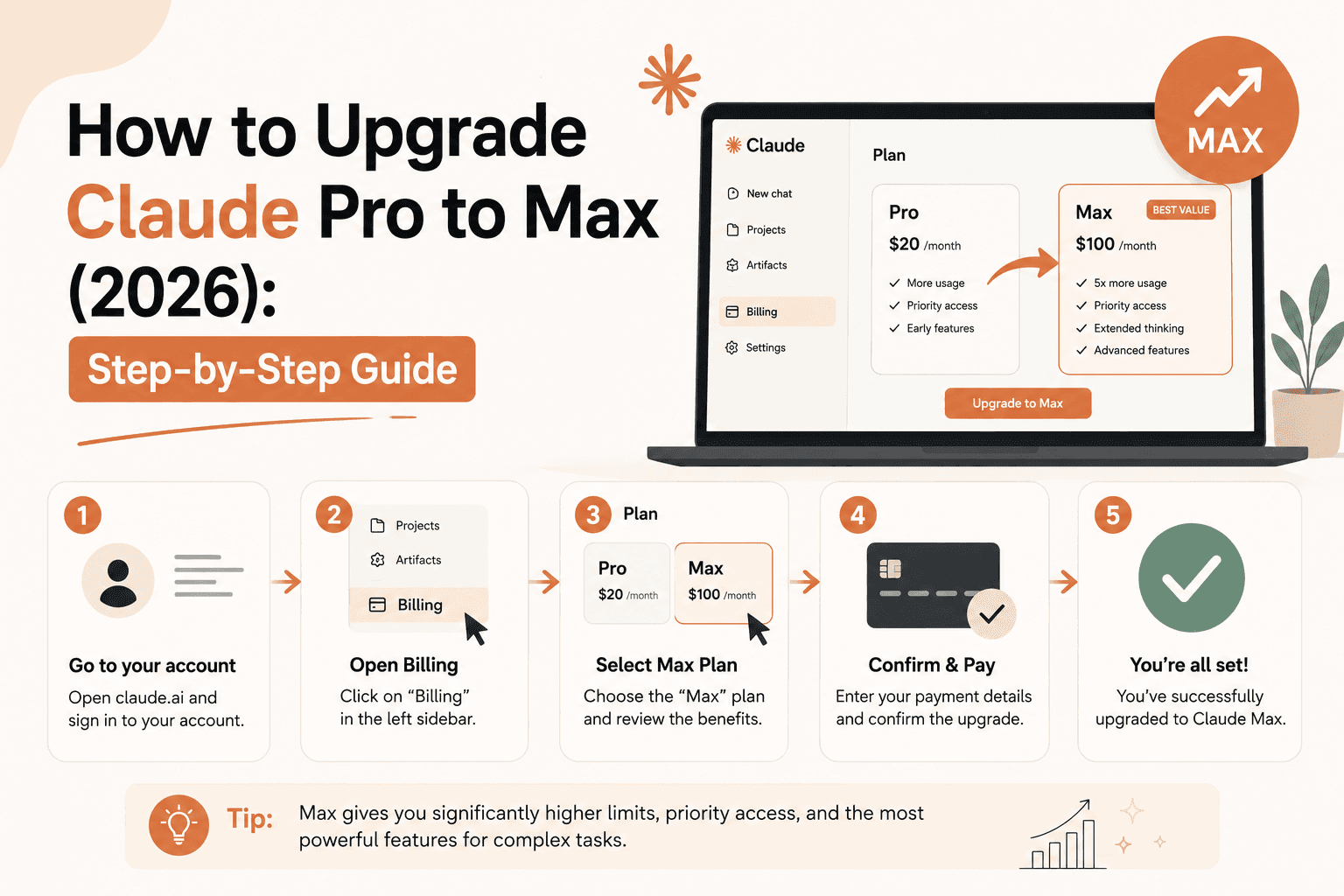
How to Upgrade Claude Pro to Max (2026): Step-by-Step Guide

Sora Alternatives: What to Use Now That It's Gone (2026)