Sora Alternatives: What to Use Now That It's Gone (2026)
OpenAI's Sora is fully shut down. Here's how Google Veo, Kling, Runway, Seedance, and Wan actually compare, and which one fits your specific workflow.
Sora Alternatives: What to Actually Use Now That It's Gone (2026)
OpenAI shut down Sora's consumer app in April 2026 and discontinued the API entirely on September 24, 2026 — it's not a maintenance pause, it's gone. Google Veo 3.1 is the closest like-for-like replacement for most people: strong physics, cinematic quality, native audio, and it's now the default recommendation across nearly every comparison published since the shutdown. If camera control and editing matter more than raw generation, Runway Gen-4.5 is the better fit, partly because it bundles Veo and Kling into the same subscription anyway. Budget-focused creators should look at Kling 3.0 or Wan 2.7, and anyone who specifically needs free-tier commercial rights should check Pika before anything else.
Why you're reading this right now
If you're here, one of two things happened: you built something on the Sora API and it stopped working on September 24, 2026, or you were a casual user who liked Sora's output and are now looking for whatever replaced it. Both situations have the same starting point — Sora isn't coming back in any form, through the app, through ChatGPT, or through the API, and OpenAI has said it will permanently delete associated data once any final export window closes. If you have content in Sora you haven't backed up, the export tool at sora.chatgpt.com/sunset is the first thing to deal with before anything in this guide.
What actually made Sora worth replacing well
Before picking a replacement, it's worth being specific about what Sora was actually good at, since "best Sora alternative" means different things depending on which part of Sora you relied on:
- Physics accuracy — realistic weight, cloth movement, water, and object interaction that held up better than most competitors at the time
- Cinematic, narrative mood — output that looked and felt like a film still rather than a generic clip, which made it a favorite for concept trailers and story-driven content
- Tight ChatGPT integration — for a while, generating video without leaving a chat conversation was a real convenience that few competitors matched
Any tool that only nails one of these three isn't really a full replacement — it's worth being honest about which one you actually need back before picking.
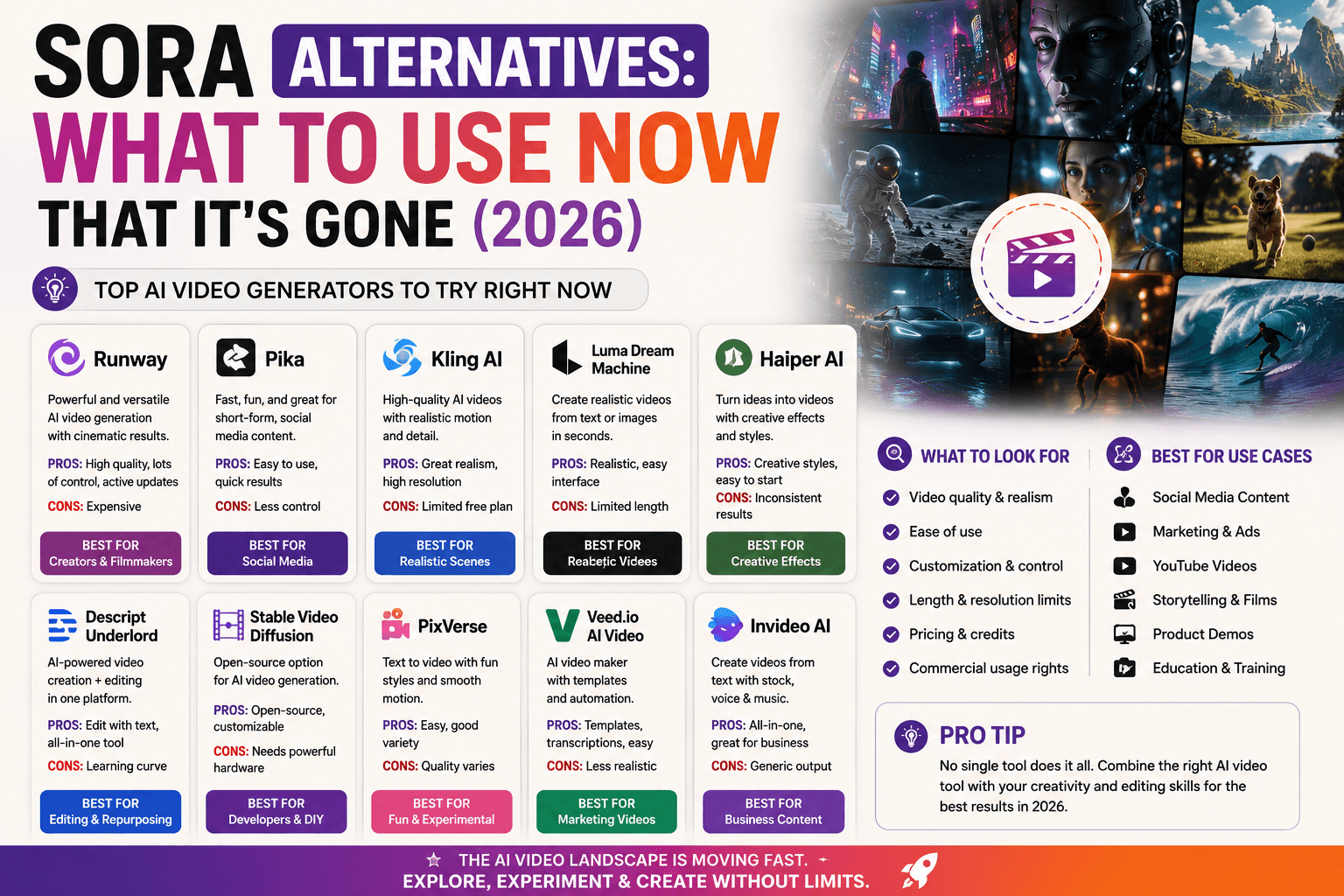
Sora alternatives compared
| Tool | Closest Sora strength matched | Audio | Pricing | API available |
|---|---|---|---|---|
| Google Veo 3.1 | Physics + cinematic mood | Native synced audio | ~$0.15/sec (fast tier); bundled in Google AI plans | Yes, via Google AI Studio |
| Runway Gen-4.5 | Camera control, not raw physics | Via bundled models | ~$12–15/mo (Standard) | Yes |
| Kling 3.0 | Multi-shot character consistency | Limited | ~$6.99/mo (Standard) | Yes |
| Seedance 2.0/2.5 | Cinematic quality + speed | Native lip-sync | Varies by region/platform | Varies |
| Wan 2.7 | Budget-friendly, open-weight | Auto-generated ambient audio | ~$0.05/sec | Yes, open-weight |
| Pika | None specifically — different use case | Varies | Free tier (commercial use allowed) + paid | Limited |
| PixVerse V6 | Multi-shot, social-ready | Native audio | Free tier + paid | Yes |
Pricing and access change often in this category — confirm current terms directly before building a production workflow around any single tool. For the full 15-tool comparison this is drawn from, see our best AI video generator roundup.
The top four, reviewed against Sora's own standard
Google Veo 3.1 is the one tool on this list that genuinely competes with what Sora was known for rather than just offering something different. Physics simulation holds up well, the cinematic quality is there, and native audio generation is arguably better than what Sora shipped with. It's accessible through Google Flow for casual use or Google AI Studio for API access, which covers both the consumer and developer migration paths at once. If you only switch to one tool, this is the one.
Runway Gen-4.5 solves a different problem well: it's less a single model to compare against Sora and more a production environment that happens to include Veo and Kling as selectable engines inside it, alongside dedicated editing tools like Act-Two for performance capture. If what you actually miss about Sora was the ability to iterate and refine a shot, Runway's editing layer is arguably a step up, even though its own native model isn't the headline feature here.
Kling 3.0 doesn't try to match Sora's narrative mood directly — its strength is multi-shot character consistency, keeping the same subject recognizable across several generated clips, which matters more for episodic or branded content than for one-off cinematic shots. It's also meaningfully cheaper than Veo at the entry tier, which makes it the practical pick for anyone whose Sora use was high-volume rather than high-polish.
Seedance is the closest match to Sora's specific "feels like a movie" quality, and it's also the fastest tool in this entire category — independent testing has clocked a 10-second clip in roughly 30 seconds, well ahead of most competitors. The catch is access: it's not sold as one universal product the way Veo or Runway are, so you're evaluating it through whichever platform licenses it rather than a single consistent experience.
Which one should you actually switch to
- You were a casual Sora app user who liked cinematic output: Google Veo 3.1, via Google Flow. It's the closest thing to picking up where Sora left off.
- You're a developer who built on the Sora API: Google AI Studio's Veo API is the most direct migration path, with the Wan 2.7 open-weight model as a cheaper fallback if you're cost-sensitive rather than quality-maximizing.
- You're a filmmaker or narrative creator chasing Sora's cinematic mood specifically: Seedance, if you can get reliable access through a platform that licenses it, or Veo 3.1 if you want something available everywhere without regional inconsistency.
- You're a marketer or small business making ad content: Runway Gen-4.5 or Veo 3.1 — both are commonly recommended for product and brand footage, with Runway's editing tools adding real value if you're refining shots rather than generating once and done.
- You're a social media creator making short-form content at volume: Kling 3.0 or PixVerse — cheaper, built for repeatable short clips, less focused on single-shot cinematic polish.
- You're budget-constrained or a hobbyist: Wan 2.7 for the lowest cost per second, or Pika specifically if you need commercial-use rights without paying anything.
- You actually wanted talking-head or presenter-style video, not cinematic clips: Neither Sora nor any tool above was really the right fit — Synthesia or HeyGen serve that use case directly.
If you built something on the Sora API
A few practical steps if you had a product or workflow depending on the Sora API rather than casual personal use:
- Confirm your export is done. If you haven't pulled your generated content and prompt/reference data from Sora's sunset tool, that's no longer optional — OpenAI has stated data gets permanently deleted after the final export window.
- Re-point API calls to a replacement. Google AI Studio's Veo endpoint is the most direct swap for general-purpose generation; Wan's open-weight model is worth evaluating if you want to self-host rather than depend on another vendor's API long-term.
- Expect to re-tune prompts. Each model interprets camera, lighting, and motion language slightly differently — a prompt that worked well on Sora won't necessarily produce the same result elsewhere without adjustment.
- Re-test cost assumptions. Per-second and per-credit pricing varies enough between tools that a workflow built around Sora's cost structure may land in a meaningfully different place on a new platform — model this before committing to volume.
Hands-on: the same prompt, five tools
Running one prompt built in Sora's own style — a slow tracking shot through a rain-soaked city street at night, reflections in puddles, a figure walking away from camera — across Veo, Runway, Kling, Seedance, and Wan surfaced some real differences, not just marketing claims.
Veo's version was the most immediately convincing on physics specifically — the puddle reflections and the way rain interacted with the pavement looked right without needing a second attempt, which matched its reputation as the closest thing to Sora's old strength. Seedance's result had a similar cinematic quality and came back dramatically faster, though a second look showed a slightly over-smoothed background that read as artificial on close inspection, a trade-off that tracked with what independent testing has noted about it generally. Kling's output was solid but noticeably less atmospheric — correct motion, flatter mood — which fits its positioning as a value and consistency pick rather than a cinematic one. Runway's native engine result was comparable to Kling's on its own, but running the same prompt through Veo inside Runway's interface produced the strongest result of the whole test, which says more about Runway's value as an access point than about its own standalone model. Wan's version was the roughest of the five — usable, clearly the budget option, with some physics breakdown in how the rain moved — but at a fraction of the cost of the others, which is exactly the trade-off it's built around.
The honest takeaway: if cinematic physics specifically was what you miss about Sora, Veo and Seedance are the two actually worth testing head to head on your own content before picking one. For everything else — social content, iteration-heavy workflows, budget-constrained volume — the "best" choice has much less to do with replicating Sora and more to do with what you're actually making.
FAQ
What is the best alternative to Sora? Google Veo 3.1 is the most commonly recommended replacement for most use cases, matching Sora's physics and cinematic quality most closely while adding native audio. The better fit depends on your specific use: Runway for editing control, Kling for cost and consistency, Seedance for the closest cinematic feel where access is available.
Is there a free alternative to Sora? Pika and PixVerse both offer usable free tiers, though with resolution and length limits typical of free plans in this category. Pika is notable for explicitly allowing commercial use on its free tier, which most competitors restrict to paid plans.
Can I still access Sora through the API? No. The Sora API was fully discontinued on September 24, 2026, following the consumer app shutdown in April 2026. There is no remaining access point, through the API, ChatGPT, or otherwise.
What should developers migrate to from the Sora API? Google AI Studio's Veo API is the most direct general-purpose replacement. If cost matters more than top-tier quality, Wan 2.7's open-weight model, priced around $0.05 per second, is worth evaluating as a cheaper or self-hosted alternative.
Which Sora alternative looks most cinematic? Seedance and Google Veo 3.1 are the two most consistently cited for cinematic quality and physics accuracy, the two traits Sora was best known for. Seedance's access varies by platform and region, while Veo is more consistently available.
Does any alternative integrate with ChatGPT the way Sora did? No current tool replicates that specific integration, since Sora's ChatGPT access ended along with everything else. If staying inside a single chat-based assistant matters to you, Gemini's bundled video features (including Veo access) are the closest equivalent on a different platform.
Conclusion
There isn't one single "Sora replacement" — there's a best fit depending on which part of Sora you actually relied on. Google Veo 3.1 comes closest to matching the overall package of physics, cinematic mood, and audio that made Sora notable, and it's the reasonable default if you don't have a strong reason to pick something else. But Runway's editing environment, Kling's cost-to-consistency ratio, Seedance's speed and mood, and Wan's rock-bottom pricing all serve real, different needs better than forcing everything through one "closest match" tool. Test the same prompt across two or three of these before committing — the gap between them is bigger than the marketing pages suggest, and now that Sora is actually gone rather than just rumored to be going, that comparison is worth doing properly rather than guessing.
Related
Resources

Best AI Video Generator in 2026: 15 Tools Compared (Free & Paid)

How to Upgrade Claude Pro to Max (2026): Step-by-Step Guide

Free AI Video Generator (2026): What You Actually Get for $0

Best AI Tools for Every Use Case in 2026?