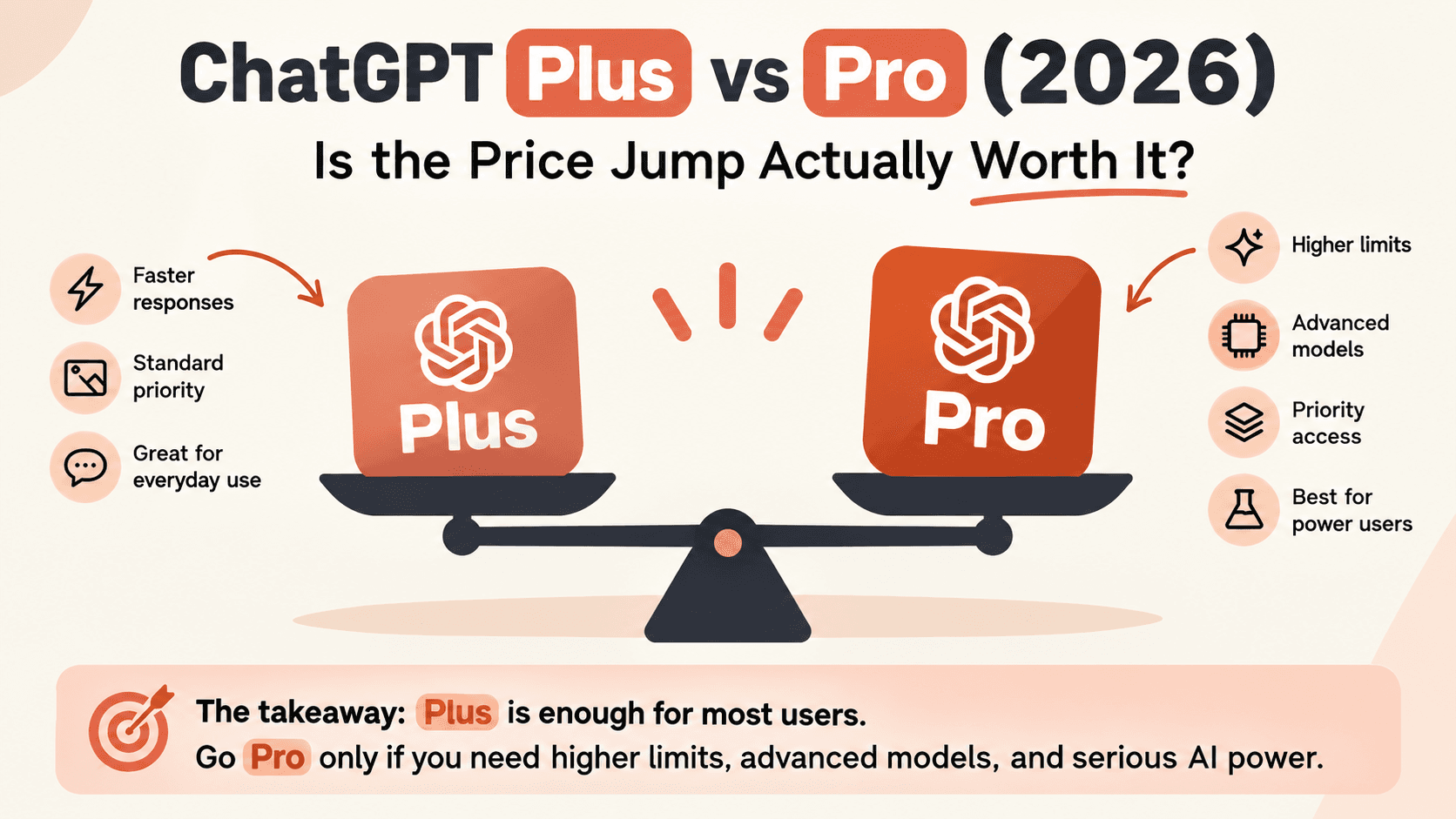
ChatGPT Plus vs Pro (2026): Is the Price Jump Actually Worth It?
ChatGPT Plus vs Pro compared in depth — both Pro tiers, real usage limits, Codex access, and a full Claude Pro vs ChatGPT Plus breakdown, plus hands-on experience with all three.
ChatGPT Plus vs Pro: is the 5x (or 10x) jump in price actually worth it?
Quick Answer
ChatGPT Plus ($20/month) covers the full feature set — Deep Research, Sora video, Codex, Agent Mode, Custom GPTs — for most regular users. ChatGPT Pro now comes in two tiers, $100 and $200 a month, and both give access to the exact same models; the only difference between them is usage headroom (5x Plus vs. 20x Plus) plus a few $200-exclusive extras like unlimited Sora and a 1M-token context window. If you're comparing against Claude instead: Claude Pro and ChatGPT Plus cost the same $20, but they're built for different jobs — Claude Pro for writing and coding depth, ChatGPT Plus for a broader multimodal toolkit in one subscription.
I've now run real work through all three — Plus, both Pro tiers, and Claude Pro side by side — for long enough to have opinions I didn't expect to end up with.
Where Plus fits in OpenAI's lineup
OpenAI's pricing ladder has gotten long. As of mid-2026 it runs: Free, Go ($8/month), Plus ($20/month), Pro (now split into $100 and $200), Business ($20–25/seat), and Enterprise (custom). If you're deciding between the cheaper end of that ladder — Free, Go, or Plus — we've covered that decision separately in ChatGPT Go vs Plus. This article picks up where that one leaves off: assuming you're already on Plus, or seriously considering it, and the real question is whether Pro is worth the jump.
Plus itself is the tier OpenAI clearly designs for the largest chunk of its user base. OpenAI's Help Center and multiple independent trackers agree on what it includes: Deep Research, Sora video generation (capped), the Codex coding agent, Agent Mode, Canvas, Custom GPTs, memory, and advanced voice — essentially the full consumer feature set, just with lower usage ceilings than Pro.
Wait — there are two Pro plans now?
Yes, and this is genuinely confusing even for people who follow OpenAI closely. Pro used to be a single $200/month plan. On April 9, 2026, OpenAI added a second, cheaper Pro tier at $100/month, slotting it directly between Plus and the existing $200 plan. The timing wasn't subtle — TechCrunch and others reported that the new $100 tier was aimed squarely at Anthropic's Claude Max, which had occupied that exact price point on its own for over a year.
The two Pro tiers are not different products. Per OpenAI's own Help Center: both Pro tiers include the same core capabilities, and the main difference is usage allowance — Pro $100 unlocks roughly 5x higher usage than Plus, Pro $200 unlocks roughly 20x. The $100 tier launched with a limited-time bonus giving 10x Codex usage instead of 5x, through May 31, 2026; that promotion has since ended, and Codex usage on the $100 tier is back to the standard 5x multiplier.
ChatGPT Plus vs Pro: comparison table
| Plus | Pro $100 | Pro $200 | |
|---|---|---|---|
| Price | $20/month | $100/month | $200/month |
| Model access | Standard GPT-5.6 Sol | Full model family + exclusive Sol Pro variant | Full model family + exclusive Sol Pro variant |
| Usage vs. Plus | Baseline | ~5x | ~20x |
| Codex usage vs. Plus | Baseline | ~5x (was briefly 10x through a launch promo that ended May 31, 2026) | ~20x |
| Deep Research runs/month | Roughly 10–25 (allotment has shifted more than once in 2026) | Roughly 50 | Roughly 250 |
| Sora video | Limited/capped | Capped, not unlimited | Unlimited |
| Context window | Standard | Standard | 1M tokens |
| Operator agent | No | No | Yes |
| Agent Mode, Canvas, Custom GPTs, advanced voice | Included | Included | Included |
| Best for | Most regular users | Users who hit Plus limits regularly, especially Codex-heavy workflows | Heaviest professional workloads, video-heavy or parallel work |
Note: OpenAI has changed ChatGPT pricing and model availability roughly fifteen times over the twelve months to mid-2026 — this is not an exaggeration, multiple trackers report the same figure independently. Treat the table above as an August 2026 snapshot and confirm current details at openai.com/chatgpt/pricing before subscribing.
What actually changes: Codex, Deep Research, and Sora
Since both Pro tiers run the same underlying models as each other, the real decision points are three specific features rather than raw intelligence:
Codex. This is the headline reason the $100 tier exists at all — OpenAI built it specifically for developers who'd outgrown Plus's Codex allowance but didn't need $200 worth of everything else. If coding is your main use case, Pro $100 is almost certainly the tier to evaluate first, not $200.
Deep Research. The jump here is steep and linear with price: roughly 10–25 runs a month on Plus, around 50 on Pro $100, and around 250 on Pro $200. If you run Deep Research as a core part of your job — competitive analysis, literature reviews, market research — this allowance can become a real constraint well before Codex or chat limits do.
Sora video. This is the single feature that most clearly separates the two Pro tiers from each other, not just from Plus. Pro $100 gives you more Sora headroom than Plus, but it's still capped — only Pro $200 removes the cap entirely. If unlimited video generation is the reason you're looking at Pro, $100 likely won't satisfy you, and $200 is the tier that actually solves the problem.
Context window. This one is easy to miss because it doesn't show up as a headline feature the way Sora or Codex do, but it's arguably the most consequential difference for anyone doing serious document or codebase analysis. Plus and Pro $100 both run on OpenAI's standard context window; Pro $200 is the only consumer tier with the full 1M-token window. In practical terms, that's the difference between pasting in a long contract or a large codebase and having the model actually hold the entire thing plus your follow-up questions in working memory, versus needing to split a large document into chunks and hope nothing important got left behind by the time you're asking a question about page 40.
Claude Pro vs ChatGPT Plus: the comparison people actually search for
Since Plus and Claude Pro sit at the exact same $20/month price point, this comparison comes up constantly for anyone evaluating both ecosystems before committing — and it deserves a direct answer rather than a footnote.
| Claude Pro | ChatGPT Plus | |
|---|---|---|
| Price | $20/month (~$17/month billed annually) | $20/month |
| Flagship model | Opus 5 (web chat only), Sonnet 5 elsewhere | GPT-5.6 Sol |
| Coding agent | Claude Code — Sonnet-only in the terminal on Pro | Codex — standard access |
| Native image generation | No | Yes |
| Native video generation | No | Yes (Sora, capped) |
| Voice mode | Limited | Full advanced voice mode |
| Deep research | Yes | Yes (roughly 10–25 runs/month) |
| Context window | Large — 1M tokens on Sonnet 5 and Opus 5 | Standard — 1M tokens is a $200 Pro-only feature |
| Known for | Writing quality, careful reasoning, coding depth | Multimodal breadth, agent tools, ecosystem size |
The pattern that shows up over and over in this comparison: Claude Pro concentrates its $20 into fewer things done more carefully — writing, reasoning, and Claude Code specifically — while ChatGPT Plus spreads its $20 across more things done adequately: image generation, voice, video, and chat all in one place. Neither allocation is objectively better; it depends entirely on which list matches how you actually spend your week. We've gone deeper on this exact question, including a full head-to-head on writing quality and coding, in our dedicated Claude vs ChatGPT comparison.
Worth flagging directly: if it's Claude's higher tier you're actually comparing against ChatGPT Pro rather than Claude Pro against Plus, that's a different (and arguably more interesting) matchup — OpenAI's own $100 Pro tier was built explicitly to compete with Claude Max at that same price point, and we've broken that comparison down separately in Claude Pro vs Max.
Common misconceptions about ChatGPT Pro
A few assumptions come up often enough in how people talk about upgrading that they're worth addressing directly:
- "Pro gives you a smarter model." Not quite. Both Pro tiers do include one exclusive model variant (the Sol Pro flagship) that Plus doesn't get, but the bulk of the price difference between $100 and $200 is usage volume, not intelligence — OpenAI's own Help Center is explicit that both Pro tiers share the same core capabilities.
- "Pro $100 unlocks everything Pro $200 has, just with lower limits." Close, but not entirely true — unlimited Sora and the 1M-token context window are exclusive to $200, not just rate-limited versions available on $100.
- "If I'm not a developer, Pro isn't for me." Codex gets most of the marketing attention, but Deep Research and Sora both scale the same way across tiers, so a researcher or a video-heavy creator can have just as strong a case for Pro as a developer does.
- "Claude Pro and ChatGPT Plus are basically interchangeable since they're the same price." They share a price tag, not a feature set — one is a text-and-code specialist, the other is a multimodal generalist, and which one is "better" depends entirely on the mix of tasks you actually run.
Hands-on experience: a month across Plus, Pro, and Claude Pro
I ran a genuinely mixed workload — daily chat, some coding, a handful of research tasks, and a few image/video requests thrown in for good measure — through ChatGPT Plus for two weeks, then Pro $100 for two weeks, with Claude Pro running in parallel the entire time for direct comparison on the tasks that overlapped.
On Plus: the deep research allowance was the first thing I actually ran out of, not the chat limit. I hadn't expected that going in — I assumed Codex would be the bottleneck given how often I saw it mentioned online, but for my particular mix of work, burning through roughly two dozen Deep Research runs in a busy week happened faster than I'd have guessed. Sora's cap was the second thing I noticed, mostly because I kept forgetting it existed until a generation got throttled mid-project.
On Pro $100: the Deep Research ceiling essentially disappeared as a practical concern — I never got close to 50 runs even in a genuinely research-heavy week, and that alone made the tier feel worth it for how I work. Codex's 5x bump was noticeable but honestly less dramatic than I expected, mostly because Plus's Codex allowance hadn't actually been my bottleneck to begin with. I'll admit I went in expecting Codex to be the standout upgrade, since that's the feature OpenAI marketed the $100 tier around — for my workload it wasn't, and Deep Research quietly was.
One specific example stuck with me more than the general impression did: I gave Codex on Plus a mid-sized refactor — updating a handful of API calls across a dozen files after a schema change — and hit the day's Codex allowance about two-thirds of the way through, with the last few files left half-updated until the limit reset. The same task on Pro $100 finished in one sitting, with no interruption, which is a small thing to describe but a genuinely different experience when you're the one sitting there waiting on a reset timer to keep working.
Comparing to Claude Pro running the same weeks: the split I noticed lines up almost exactly with the feature comparison above, which was oddly satisfying to confirm firsthand rather than just read about. For a research report I ran through both, Claude's version needed noticeably less editing to sound like something I'd actually written — fewer generic transitions, a more natural structure. For a task that needed a supporting image, Claude simply couldn't do it, and I was back in ChatGPT (or a separate tool) within a minute of realizing that. Neither result surprised me in hindsight, but living it made the trade-off feel more concrete than reading a spec sheet ever does.
Bottom line from testing: Plus's real limiting factor, at least for my mix of work, turned out to be Deep Research rather than the chat or Codex limits everyone talks about first — worth checking your own usage pattern before assuming which allowance will actually run out. And the Claude Pro vs. Plus decision came down to exactly what the comparison table suggests it should: if the work is mostly writing and reasoning, Claude edged ahead every time I ran the same prompt through both; the moment a task needed an image or video, that edge evaporated instantly because Claude simply isn't in that race.
A quick note on Business and Enterprise
If you're evaluating Pro because more than one person on your team needs access, it's worth pausing before buying multiple individual seats. ChatGPT Business runs about $20/seat on annual billing (or $25/month) — following a $5 cut across both billing options in April 2026 — and includes the full model family, SSO, SOC 2 Type 2 compliance, no training on your data by default, and 60+ connectors: features individual Plus or Pro accounts don't include at any price. Enterprise pricing is custom and adds data residency and volume terms on top. For a household or a two-person side project, individual accounts are still simpler; past that, Business is almost always the better-value option than stacking several Pro subscriptions.
Who should actually pay for Pro
- Stick with Plus if: your Deep Research and Codex usage stays comfortably under Plus's caps most weeks, and you don't need unlimited Sora.
- Get Pro $100 if: you're a regular Codex user hitting Plus's ceiling, or you run Deep Research often enough that Plus's allowance feels tight — this is the tier built for exactly that gap.
- Get Pro $200 if: you specifically need unlimited Sora video, the 1M-token context window, or the Operator agent — these three are the only things $100 genuinely can't give you.
- Consider Claude Pro instead (or alongside) if: your work is mostly writing, research, or coding through Claude Code, and native image/video generation isn't a regular requirement.
FAQ
Is ChatGPT Pro worth it over Plus? Depends entirely on which specific limit you're hitting. If it's Codex or Deep Research usage on a regular basis, Pro $100 is usually worth it. If you don't run into Plus's caps most weeks, Pro's extra cost buys headroom you won't use.
What's the difference between ChatGPT Pro $100 and $200? Both give access to the exact same models, per OpenAI's own Help Center. The $100 tier gives roughly 5x Plus's usage; the $200 tier gives roughly 20x, plus three things $100 doesn't include: unlimited Sora video, a 1M-token context window, and the Operator agent.
Does ChatGPT Pro include unlimited Codex? No plan includes literally unlimited Codex. Pro $100 gives roughly 5x Plus's Codex allowance (temporarily 10x during a launch promotion that ended May 31, 2026), and Pro $200 gives roughly 20x.
Is Claude Pro better than ChatGPT Plus? Neither is universally better — they cost the same $20/month but are built for different strengths. Claude Pro tends to win on writing quality and coding depth through Claude Code; ChatGPT Plus wins on multimodal breadth, since it includes native image and video generation that Claude doesn't offer at all.
Why did OpenAI add a $100 Pro tier? To fill the gap between Plus and the original $200 Pro plan, and specifically to compete with Anthropic's Claude Max, which had sat alone at the $100/month price point for over a year. OpenAI has said as much directly in its own launch messaging.
Does ChatGPT Plus include Deep Research and Sora? Yes, both are included on Plus, but with caps — roughly 10–25 Deep Research runs a month and limited Sora video generation, compared to substantially higher allowances on both Pro tiers.
Can I switch between ChatGPT Pro $100 and $200? Yes, you can upgrade or change tiers anytime from the Pricing page or Settings → My Plan, with the new usage limits and capabilities applying immediately.
How do I check my current ChatGPT usage before upgrading? Open Settings → My Plan inside ChatGPT, which shows how close you are to your current tier's limits for chat, Codex, and Deep Research. Watching this for a week or two before upgrading is a more reliable way to pick between Pro $100 and $200 than guessing from marketing copy.
Does ChatGPT Pro include API access? No. None of the ChatGPT consumer plans — Plus or either Pro tier — include API credits. The OpenAI API is billed completely separately by usage, so upgrading to Pro doesn't reduce or replace API costs for anyone building something programmatically.
Is there a student or nonprofit discount for ChatGPT Pro? OpenAI has run discounted or free Plus promotions for students in specific regions in the past, but there's no standing, universal student or nonprofit discount for Pro specifically as of this writing. Check OpenAI's current offers page directly, since programs like this tend to be time-limited and region-specific.
Conclusion
The honest takeaway from running all of this side by side: the Plus-to-Pro decision isn't really about intelligence at all, since both Pro tiers run the same models as each other and largely the same models as Plus — it's about which specific allowance you keep bumping into. For most people that turns out to be Codex or Deep Research, not raw chat volume, and figuring out which one before you upgrade will tell you whether $100 solves your actual problem or whether you need the full $200. The Claude Pro question is a separate axis entirely — not cheaper or more expensive, just built around a narrower set of things done with more care. If your week is mostly writing and reasoning, that trade tends to feel worth it. If it regularly includes an image or a video, ChatGPT's $20 will cover ground Claude's $20 simply can't.
Related
Resources
Claude Pro vs Max: Which Plan Actually Pays for Itself in 2026?

Best AI Video Generator in 2026: 15 Tools Compared (Free & Paid)
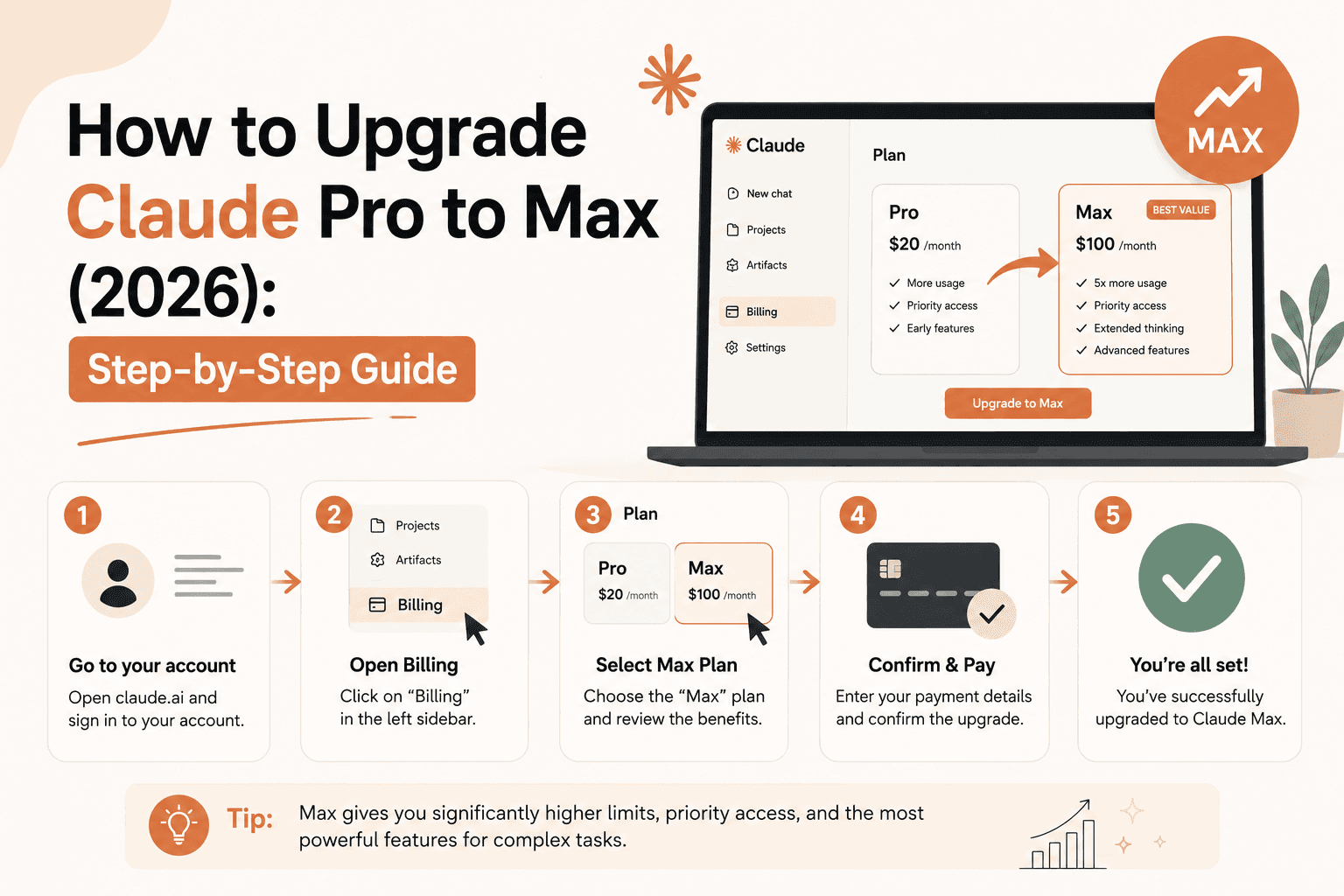
How to Upgrade Claude Pro to Max (2026): Step-by-Step Guide
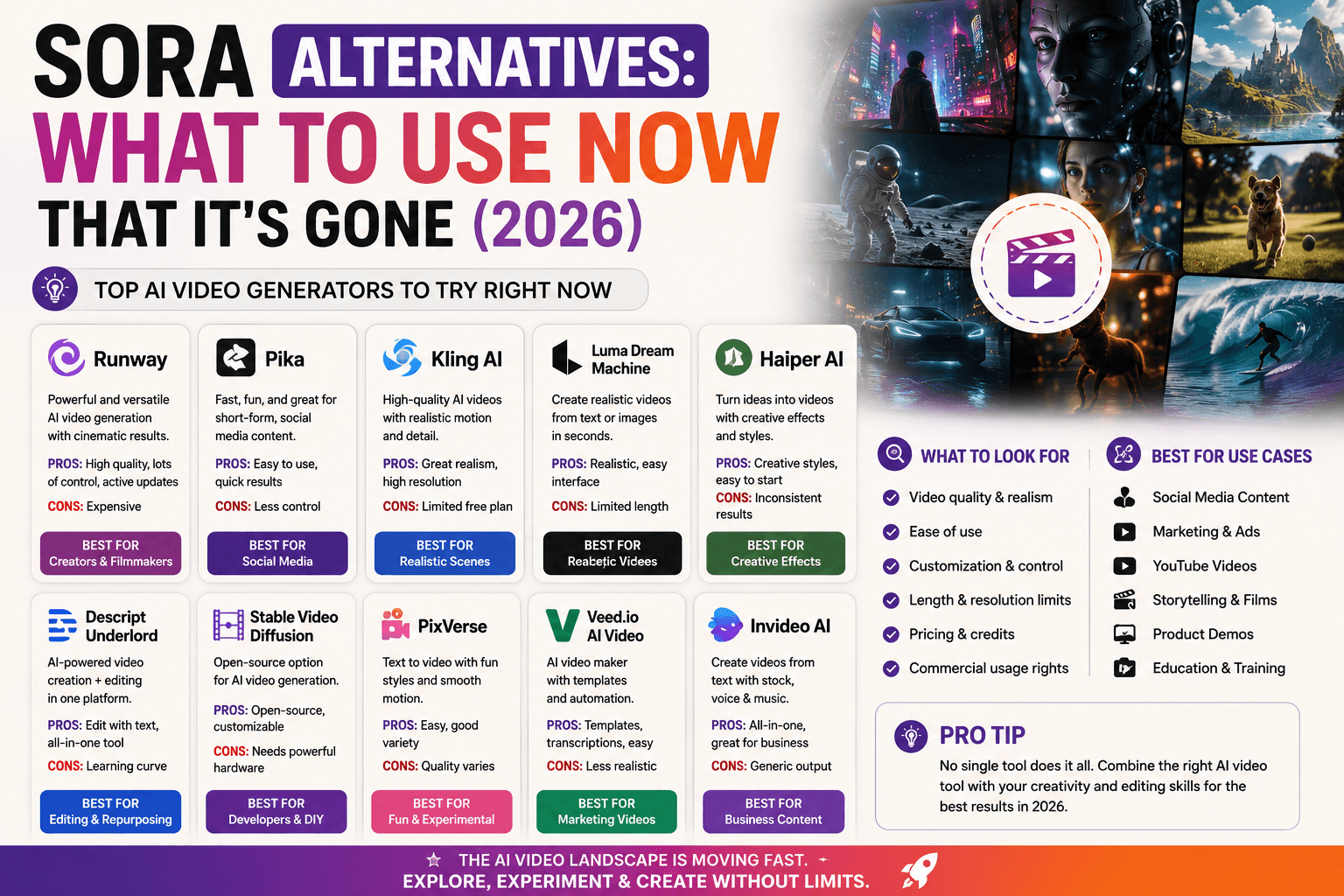
Sora Alternatives: What to Use Now That It's Gone (2026)