
Cognitive Load in Modern Software Architecture: A Visual Guide
Explore the abstract boundaries of cognitive load in distributed systems and microservices. Learn how architectural choices impact team velocity and how to design for maintainability.
Cognitive Load in Modern Software Architecture
As systems scale into sprawling microservices architectures, the true bottleneck often isn't CPU or network latency—it's human cognitive load. Engineering teams face an overwhelming amount of context switching, domain knowledge, and operational complexity. When the mental model required to safely deploy a change exceeds what a single engineer can hold in their head, development slows to a crawl, and incidents become more frequent.
Understanding Cognitive Load
Cognitive load theory, originally from cognitive psychology, categorizes mental effort into three types:
- Intrinsic Cognitive Load: The inherent difficulty of the task itself. For example, writing a complex sorting algorithm or understanding business logic for tax calculations.
- Extraneous Cognitive Load: The environment in which the task is done. This includes dealing with poorly documented APIs, confusing deployment pipelines, or deciphering a tangle of microservices.
- Germane Cognitive Load: The mental effort put into creating a permanent store of knowledge (learning).
In software architecture, our goal is to minimize extraneous cognitive load so that engineers have more mental capacity available for the intrinsic and germane load.
The Abstract Boundaries of Services
When we design distributed systems, we often draw clean, architectural diagrams with well-defined boundaries. However, the reality of maintaining these systems is far more abstract.
An Example: The Distributed Monolith
Consider an e-commerce platform that was recently "migrated" to microservices.
- Service A (Cart) calls Service B (Inventory) to check stock.
- Service B synchronously calls Service C (Warehouse) and Service D (Pricing).
- Service D depends on a shared database with Service E (Promotions).
If a developer needs to add a new "Buy One Get One Free" promotion, they have to understand the interplay between Cart, Pricing, and Promotions. They must coordinate deployments across three repositories and worry about cascading failures if the Inventory service times out.
The extraneous cognitive load here is massive. The developer isn't just solving a business problem; they are solving a distributed systems orchestration problem.
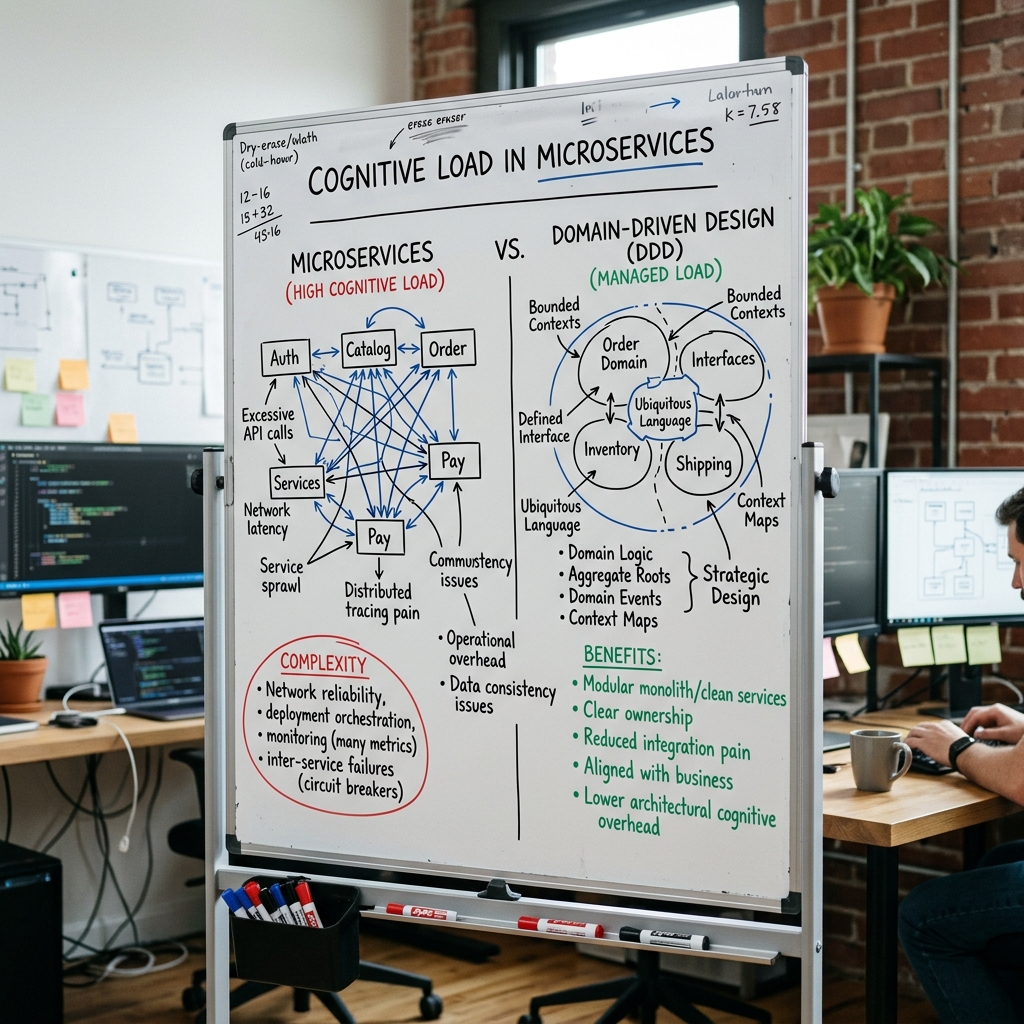 A realistic engineering whiteboard diagram exploring the cognitive boundaries between microservices.
Designing for Maintainability
To combat this, modern architectural decisions must treat cognitive load as a primary metric. How do we build systems that don't exhaust our engineering teams?
1. Domain-Driven Design (DDD)
Align service boundaries with business domains rather than technical functions. By creating Bounded Contexts, we limit the blast radius of changes.
If the "Promotions" team owns everything related to discounts, from the API down to the database schema, they don't need to understand the internal workings of the "Inventory" team. They communicate via well-defined, versioned contracts (like events on an event bus). This isolation significantly reduces the amount of system state a developer needs to hold in their head.
2. Platform Engineering
One of the largest sources of extraneous cognitive load is operational complexity: configuring Kubernetes manifests, setting up CI/CD pipelines, managing Terraform state, and instrumenting observability.
Platform engineering provides "paved paths" or golden paths. By abstracting these concerns away from application developers into self-service internal developer platforms (IDPs), developers can focus purely on business logic. They don't need to be Kubernetes experts to deploy a service safely.
3. Clear Contracts and Schemas
Relying on implicit contracts (e.g., untyped JSON payloads) forces developers to read another team's source code to understand how to interact with their service.
Instead, use strict schemas like Protobuf, GraphQL, or OpenAPI. These act as executable documentation. When the contract is clear and enforced by tooling, the cognitive load required for integration drops near zero.
Conclusion
The architectures we design are deeply intertwined with the organizational structure and the well-being of the engineers who build them (Conway's Law in action). By acknowledging the limits of human memory and attention, we can build distributed systems that scale not just technically, but organizationally.
Optimize for the developer's mental model, not just the cloud bill.
Related
Resources
MCP Architecture Explained: Hosts, Clients, Servers & Data Flow
What Is MCP (Model Context Protocol)? A Complete Guide (2026)

OpenRouter API Tutorial: How to Connect & Fetch LLM Responses (JS/Node.js)

The Best AI Tools for Developers in 2026