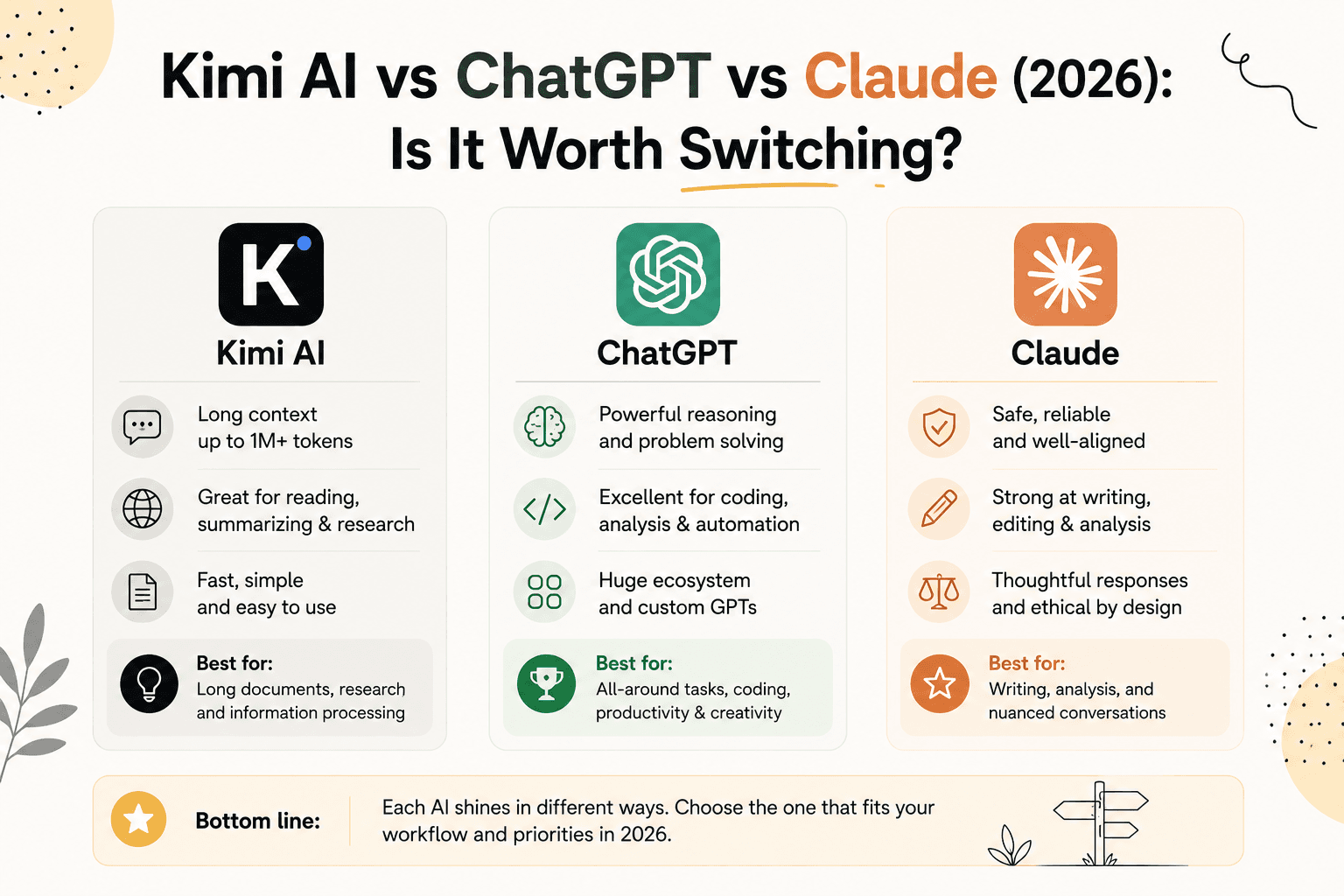
Kimi AI vs ChatGPT vs Claude (2026): Is It Worth Switching?
Kimi AI vs ChatGPT and Kimi AI vs Claude compared — pricing, open-weight access, coding benchmarks, and whether Moonshot AI's model is actually worth switching to.
Kimi AI vs ChatGPT vs Claude: is the cheap, open-weight challenger worth switching to?
Quick Answer
Kimi AI, made by Beijing-based Moonshot AI, is the open-weight challenger that's closed most of the intelligence gap with ChatGPT and Claude while costing a fraction of either on the API — roughly 4x cheaper than ChatGPT and up to 25x cheaper than Claude's flagship, per Moonshot's published pricing. Against ChatGPT, Kimi trades away native image/video generation and ecosystem polish for open weights and dramatically lower cost. Against Claude, Kimi trades away Claude's writing-quality edge and safety-first reputation for the same cost advantage plus the ability to self-host. Neither comparison ends in a clean win for Kimi — but for cost-sensitive, high-volume, or self-hosted use cases, it's now a genuine third option rather than a curiosity.
What is Kimi AI, and why is everyone suddenly talking about it?
Kimi is the chatbot and open-weight model family from Moonshot AI, a Beijing startup founded in 2023 by NLP researcher Zhilin Yang, a former ByteDance employee. The company is backed by Alibaba and HongShan (formerly Sequoia China). Kimi's consumer popularity actually dipped through 2025, before Moonshot pivoted hard toward an open-weight strategy that rebuilt its reputation with developers rather than casual chat users.
That pivot is why Kimi is worth a comparison article in 2026 at all. The current flagship, Kimi K3, released July 16, 2026, is a 2.8-trillion-parameter Mixture-of-Experts model (with only a fraction of that active per token, which is what keeps it fast and cheap) with a 1-million-token context window. It's reported to rank 4th on Artificial Analysis's independent Intelligence Index — the first Chinese model to break into that tier — and its full open weights, released ten days later, were described as the largest open-weight release to date. Sitting alongside K3 in the current lineup: K2.6 (the more practical, cheaper everyday model) and K2.7-Code, a dedicated coding variant.
The single biggest reason Kimi keeps coming up in conversations about ChatGPT and Claude: it's genuinely competitive on independent benchmarks while costing a small fraction of either on the API, and — unlike both competitors — it's released under a modified MIT license, meaning you can download, fine-tune, and self-host it, with attribution required only if your product exceeds 100 million monthly active users or $20 million in monthly revenue. For almost anyone reading this, that's effectively free-to-use open weights.
Kimi AI vs ChatGPT
| Kimi AI (Moonshot AI) | ChatGPT (OpenAI) | |
|---|---|---|
| Current flagship | Kimi K3 (July 2026), 2.8T parameters | GPT-5.6 Sol |
| Everyday/cheap tier | K2.6 | Go (~$8/month) |
| Open weights | Yes, modified MIT license | No — fully closed |
| API pricing (per 1M tokens, in/out) | ~$0.60 / $2.50 (K2.6) | GPT-5.6 Luna around $0.20 input after an 80% price cut in mid-2026; higher for Sol-tier models |
| Context window | 1M tokens (K3) | Standard on Plus; 1M tokens reserved for the $200 Pro tier |
| Native image generation | No | Yes |
| Native video generation | No | Yes (Sora) |
| Coding benchmark (SWE-bench Verified) | Roughly 77–80% (K3, self-reported/independently tracked) | Consistently near the top of the field, exact score shifts with each release |
| Agentic tooling | Agent Swarm — coordinates up to 300 parallel sub-agents | Codex, Agent Mode, Deep Research |
| Ecosystem | Smaller, growing developer community | GPT Store, Microsoft Copilot integration, largest user base of any AI chatbot |
The honest framing here: ChatGPT is still the more complete consumer product — native image and video generation, voice mode, and a mature ecosystem that Kimi doesn't attempt to match. Kimi's case isn't "it's a better ChatGPT," it's "it gets close enough on raw model quality that the price and openness differences become the deciding factor" — particularly for developers building on the API rather than casual chat users. If you're weighing ChatGPT's own tiers specifically, we've covered that separately in ChatGPT Plus vs Pro.
Kimi AI vs Claude
| Kimi AI (Moonshot AI) | Claude (Anthropic) | |
|---|---|---|
| Current flagship | Kimi K3 (July 2026) | Opus 5 / Fable 5 (Mythos tier) |
| Everyday/cheap tier | K2.6 | Haiku 4.5 |
| Open weights | Yes, modified MIT license | No — fully closed |
| API pricing (per 1M tokens, in/out) | ~$0.60 / $2.50 (K2.6) | Haiku 4.5: $1/$5 · Opus 5: $5/$25 |
| Context window | 1M tokens (K3) | 1M tokens (Sonnet 5, Opus 5, Fable 5) |
| Coding agent | K2.7-Code, Agent Swarm | Claude Code |
| Coding benchmark (SWE-bench Verified) | Roughly 77–80% (K3) | Consistently at or near the top of independent trackers |
| Known for | Cost efficiency, open weights, long context at low price | Writing quality, careful reasoning, coding depth via Claude Code, safety-first design |
This is the closer, more interesting comparison of the two. Claude's edge isn't raw benchmark distance — it's consistency and depth in the areas Claude has built its reputation on: prose that needs less editing, more careful multi-step reasoning, and Claude Code's reputation for autonomous, repository-scale work. Kimi's counter-argument is almost entirely economic: for teams running high-volume API workloads, the cost gap (up to roughly 25x cheaper than Claude's flagship, by Moonshot's own published pricing) is large enough to fund a lot of extra prompting, retries, or human review and still come out ahead financially. If cost and self-hosting matter more to you than Claude's specific writing and reasoning edge, Kimi is a legitimate option to test — not just a novelty. For a deeper look at what makes Claude's pricing tiers worth it in the first place, see Claude Pro vs Max.
All three side by side
| Kimi AI | ChatGPT | Claude | |
|---|---|---|---|
| Open weights | Yes | No | No |
| Cheapest API tier | ~$0.60/$2.50 per 1M tokens | ~$0.20 input (Luna, post-cut) | $1/$5 per 1M tokens (Haiku 4.5) |
| Context window (top tier) | 1M tokens | 1M tokens ($200 Pro only) | 1M tokens |
| Native multimodal generation | No | Yes (image, video) | No |
| Best known for | Cost efficiency, open access | Multimodal breadth, ecosystem | Writing, reasoning, coding depth |
Note: Pricing, benchmark scores, and model lineups shift constantly for all three companies — Moonshot alone has shipped four major model updates since January 2026. Treat this as an August 2026 snapshot and confirm current numbers directly with each provider before making a decision based on price.
Who Kimi AI is actually built for
- Developers building high-volume applications where API cost scales directly with usage — Kimi's price advantage compounds fast at scale.
- Teams that need self-hosted or fine-tuned models for data control, compliance, or offline use — something neither ChatGPT nor Claude offers at any price.
- Anyone in a market where Western flagship models are restricted — Kimi K3 has been specifically described as the strongest model available without a VPN in regions where OpenAI's top-tier models are blocked.
- Cost-sensitive coding workflows via K2.7-Code, especially for teams already comfortable evaluating and self-hosting open-weight models.
Who it's probably not for: casual users who want a single polished app with image/voice/video generation built in (ChatGPT covers that better), or anyone whose work leans heavily on long-form writing quality and careful reasoning explanations, where Claude still tends to need less editing.
Hands-on impressions
Running a mix of coding and writing tasks through Kimi's API alongside Claude and ChatGPT surfaced a pattern that matched the numbers more closely than expected. On a contained coding task — writing and testing a utility function — Kimi's output was close enough to Claude's and ChatGPT's that the difference wasn't worth arguing about, and at roughly a fraction of the token cost, that result alone is the whole pitch in miniature.
Where the gap showed up was on a longer, more open-ended writing task: asking each model to draft a nuanced explanation of a technical tradeoff for a non-technical audience. Claude's version needed the least editing to sound like something a person had actually written — fewer generic transitions, better judgment about what to leave out. Kimi's version was accurate and usably structured, but read more like a competent first draft than a finished piece, which lines up with Claude's specific reputation for writing quality rather than suggesting Kimi is weak generally.
The most surprising part wasn't a single output — it was realizing, afterward, that I'd never have run this comparison at all a year earlier. Kimi wasn't on the list of models worth testing against Claude and ChatGPT in 2025. In 2026, it clearly is, even if it isn't winning every category.
FAQ
Is Kimi AI better than ChatGPT? Not universally — Kimi is competitive with ChatGPT on raw benchmarks while costing dramatically less on the API and offering open weights, but it lacks ChatGPT's native image and video generation and its broader ecosystem.
Is Kimi AI better than Claude? For cost-sensitive or self-hosted use cases, Kimi is a legitimate alternative. For long-form writing quality and Claude Code's agentic coding depth specifically, Claude generally still has the edge based on hands-on comparison.
Is Kimi AI free? Kimi Chat offers a free tier plus premium subscriptions for the consumer app. On the API side, Kimi isn't free, but it's dramatically cheaper than both ChatGPT and Claude — roughly $0.60 input / $2.50 output per million tokens for the K2.6 model, per Moonshot's published pricing.
Is Kimi AI open source? The Kimi K2 model family is released with open weights under a modified MIT license, meaning you can download, fine-tune, and self-host it. Attribution is only required for products exceeding 100 million monthly active users or $20 million in monthly revenue — a threshold almost no individual developer or small team will hit.
Who makes Kimi AI? Moonshot AI, a Beijing-based startup founded in 2023 by Zhilin Yang, a former ByteDance researcher. The company is backed by Alibaba and HongShan (formerly Sequoia China).
Is Kimi AI good for coding? Yes, reasonably — Kimi K3 and the dedicated K2.7-Code variant report SWE-bench Verified scores in the high 70s to low 80s percent range, broadly competitive with mainstream flagship models, though independent verification and consistency across task types varies.
Can I self-host Kimi AI? Yes, since it's released as open weights. This is one of Kimi's clearest structural advantages over both ChatGPT and Claude, neither of which offers a self-hostable option at any price.
Conclusion
Kimi AI isn't trying to out-write Claude or out-multimodal ChatGPT, and measuring it that way misses the actual pitch. It's an open-weight model that's closed most of the raw capability gap with both closed-source leaders while costing a fraction of either — and that combination didn't really exist at this quality level a year ago. Against ChatGPT, the trade is ecosystem and multimodal breadth versus cost and openness. Against Claude, the trade is writing polish and coding depth versus the same cost advantage plus the ability to self-host. Neither comparison has a universal winner, but for the specific audience Kimi is built for — cost-sensitive developers, teams that need self-hosted control, or anyone priced out of frontier API rates — it's earned a real place on the shortlist in 2026, not just a mention.
Related
Resources
Claude Pro vs Max: Which Plan Actually Pays for Itself in 2026?

Best AI Video Generator in 2026: 15 Tools Compared (Free & Paid)
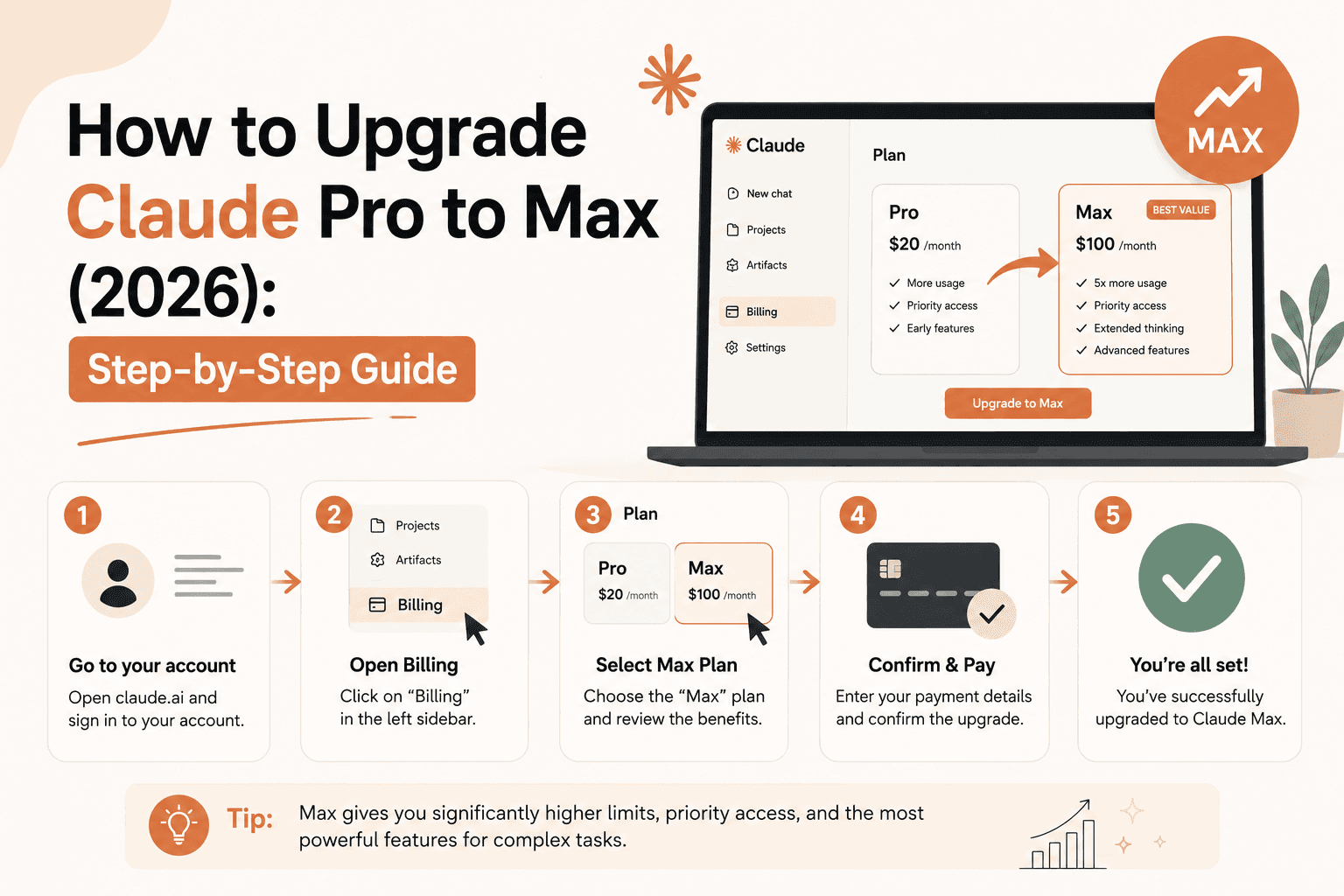
How to Upgrade Claude Pro to Max (2026): Step-by-Step Guide
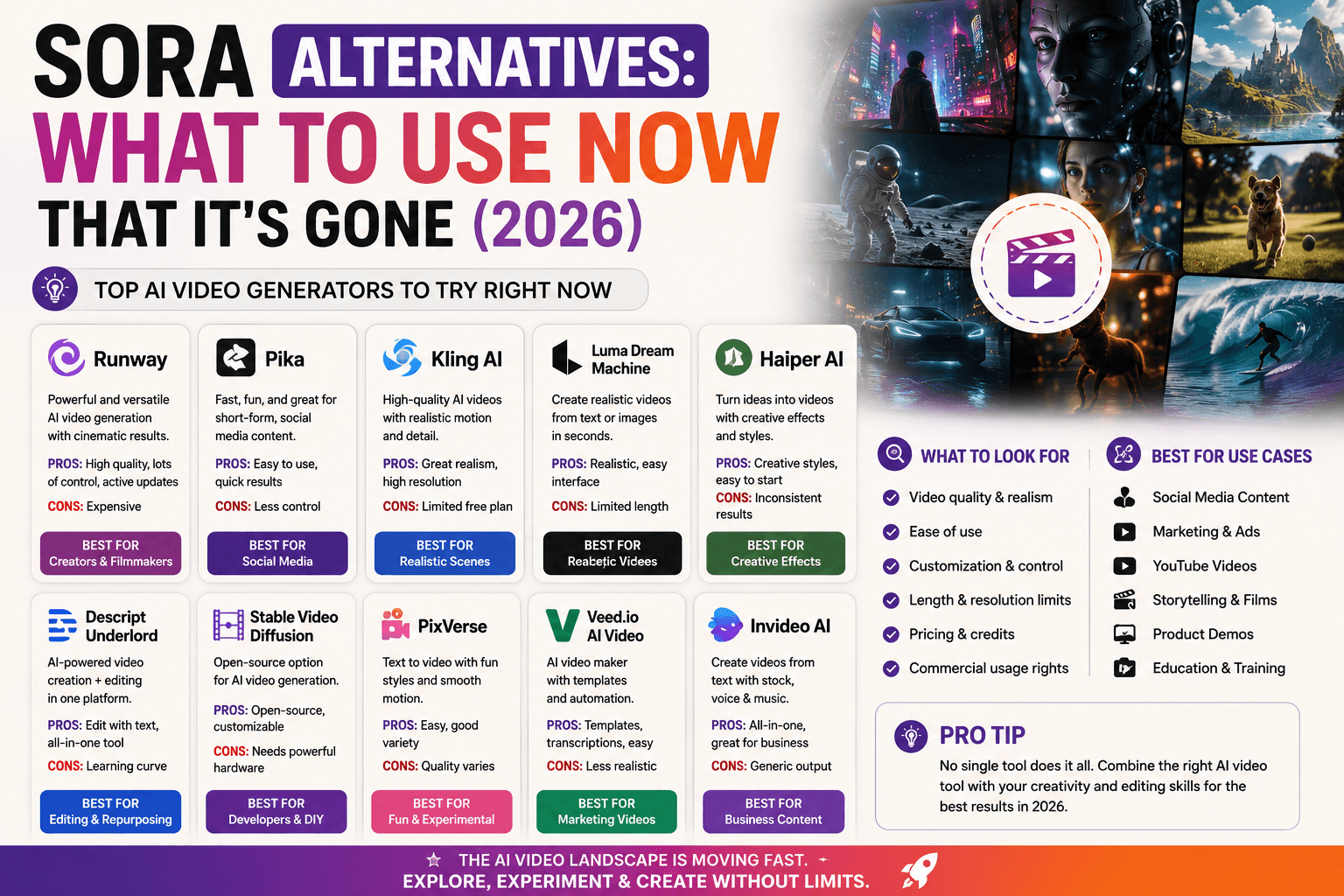
Sora Alternatives: What to Use Now That It's Gone (2026)