Mastering Angular 19 Signals: Reactive State Management for 2026
A comprehensive deep dive into Angular Signals. Learn how to migrate from RxJS, optimize change detection, and build high-performance reactive architectures in modern Angular applications.
The evolution of Angular has reached a pivotal milestone with the stabilization and enhancement of Signals in Angular 19. For years, the framework relied heavily on RxJS for managing complex asynchronous data streams and Zone.js for change detection. While incredibly powerful, RxJS often introduced a steep learning curve, boilerplate overhead, and potential performance bottlenecks if not managed with absolute precision. Enter Angular Signals—a reactive primitive that fundamentally changes how we think about state, derived values, and side effects.
In this comprehensive guide, we will dive deep into the architecture of Angular Signals, explore advanced implementation patterns, contrast them with traditional RxJS approaches, and provide practical strategies for building high-performance, local-first applications in 2026.
The Paradigm Shift: From Pull to Push-Pull
Understanding Signals requires a shift in how we conceptualize state propagation. Traditional Angular change detection, driven by Zone.js, operates on a "pull" model. When an event occurs (a click, a timer, an HTTP response), Zone.js triggers a top-down check of the entire component tree to see if anything changed. This dirty-checking process, while optimized over the years, is inherently inefficient for massive, highly interactive applications.
Signals introduce a hybrid "push-pull" reactivity model:
- Push: When a Signal's value changes, it actively notifies its dependents (computed signals or effects) that they are stale.
- Pull: When the dependent is subsequently read (e.g., during rendering), it computes and returns its new value.
This fine-grained reactivity means Angular no longer needs to guess what changed. It knows exactly which components depend on which Signals and updates only those specific parts of the DOM. The result? A theoretical change detection overhead of near zero.
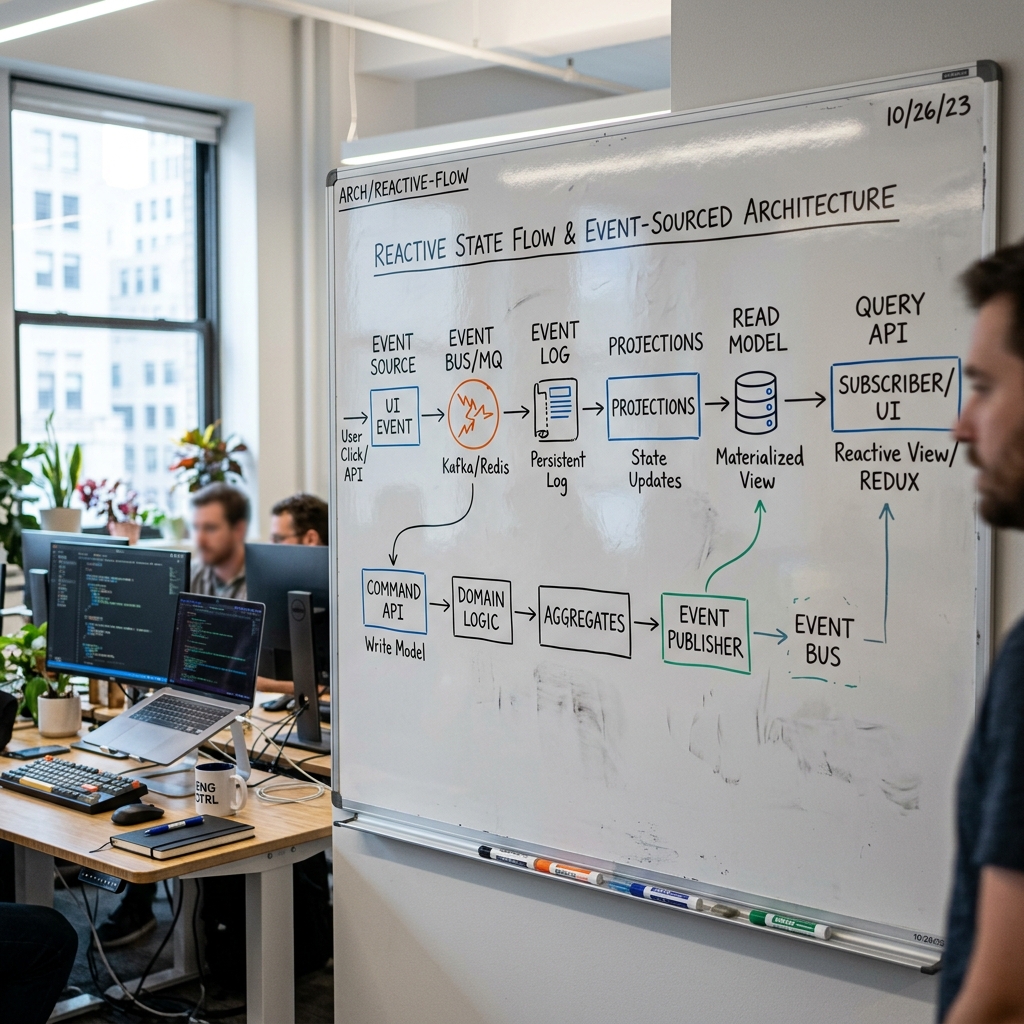
A visual representation of how Signal updates propagate through the component tree, completely bypassing unaffected sibling and parent nodes.
Core Primitives: Writable, Computed, and Effects
The Signal API is deceptively simple, built around three core primitives. Let's break them down beyond the basic documentation.
1. Writable Signals (signal)
A writable signal is the source of truth. It holds a value and provides methods to update it (set, update).
import { signal, Component } from '@angular/core';

@Component({
  selector: 'app-shopping-cart',
  template: `
    <div class="cart-badge">
      Items: {{ itemCount() }}
    </div>
    <button (click)="addItem()">Add Item</button>
  `
})
export class ShoppingCartComponent {
  // Initializing a writable signal
  itemCount = signal<number>(0);

  addItem() {
    // Updating the signal based on its previous value
    this.itemCount.update(count => count + 1);
  }
}
Pro-tip: While it's tempting to use set everywhere, always use update when the new state depends on the previous state to avoid race conditions in highly asynchronous environments.
2. Derived State (computed)
Computed signals are where the real magic happens. They are purely derived from other signals and are lazily evaluated and memoized.
import { signal, computed } from '@angular/core';

const products = signal([{ id: 1, price: 100 }, { id: 2, price: 200 }]);
const discount = signal(0.1); // 10%

const total = computed(() => {
  const currentProducts = products();
  const subtotal = currentProducts.reduce((sum, p) => sum + p.price, 0);
  return subtotal * (1 - discount());
});
Here, total will only recalculate if products or discount changes. If a component reads total() fifty times during a render cycle, the calculation happens exactly once. This is a massive performance win over traditional getter methods or pipes.
3. Side Effects (effect)
Effects are operations that run asynchronously when the signals they read change. They are the bridge between the reactive world and the imperative world (like updating localStorage, manipulating the DOM directly, or triggering network requests).
import { effect, signal } from '@angular/core';

export class ThemeService {
  theme = signal<'light' | 'dark'>('light');

  constructor() {
    effect(() => {
      // This runs initially and whenever 'theme' changes
      const currentTheme = this.theme();
      document.body.classList.toggle('dark-mode', currentTheme === 'dark');
      localStorage.setItem('app-theme', currentTheme);
    });
  }
}
Caution: Effects should rarely be used to update other signals, as this can lead to infinite loops and unpredictable state flow. If you find yourself setting a signal inside an effect, you likely need a computed signal instead.
Migrating from RxJS to Signals: A Strategic Approach
The most common question among enterprise teams is: "Should we rewrite all our RxJS code to Signals?" The answer is a resounding no. RxJS and Signals solve different problems.
RxJS is unparalleled for managing asynchronous events over time (debouncing, throttling, switching streams, WebSocket connections). Signals are designed for managing state synchronously.
The modern architecture leverages both: RxJS for the pipes, Signals for the reservoir.
The Interop API
Angular provides powerful tools to bridge these two worlds: toSignal and toObservable.
Handling HTTP Requests
Instead of managing async pipes and unsubscriptions, convert your HTTP streams directly to signals.
import { Component, inject } from '@angular/core';
import { toSignal } from '@angular/core/rxjs-interop';
import { HttpClient } from '@angular/common/http';
import { catchError, of } from 'rxjs';

@Component({
  template: `
    @if (userData()) {
      <profile-card [data]="userData()"></profile-card>
    } @else {
      <loading-spinner></loading-spinner>
    }
  `
})
export class UserProfileComponent {
  private http = inject(HttpClient);

  // Converts the observable to a signal.
  // It automatically subscribes on creation and unsubscribes on destroy.
  userData = toSignal(
    this.http.get<User>('/api/user').pipe(
      catchError(() => of(null))
    ),
    { initialValue: null }
  );
}
This pattern eliminates the dreaded ExpressionChangedAfterItHasBeenCheckedError and drastically simplifies template logic.
Advanced Pattern: The State Service Architecture
For complex applications, scattering signals across components leads to fragmentation. The modern best practice is to encapsulate signals within dedicated State Services. Let's look at an advanced, generic implementation.
import { Injectable, signal, computed } from '@angular/core';

export interface AppState {
  user: User | null;
  settings: UserSettings;
  isOnline: boolean;
}

const initialState: AppState = {
  user: null,
  settings: { theme: 'system', notifications: true },
  isOnline: navigator.onLine
};

@Injectable({ providedIn: 'root' })
export class GlobalStateService {
  // Private writable signal holds the immutable state tree
  private state = signal<AppState>(initialState);

  // Expose specific slices as read-only computed signals
  readonly user = computed(() => this.state().user);
  readonly theme = computed(() => this.state().settings.theme);
  readonly isOnline = computed(() => this.state().isOnline);

  // Strongly typed action methods
  updateUser(user: User) {
    this.state.update(s => ({ ...s, user }));
  }

  updateTheme(theme: 'light' | 'dark' | 'system') {
    this.state.update(s => ({
      ...s,
      settings: { ...s.settings, theme }
    }));
  }
}
This architecture provides the predictability of Redux (single source of truth, immutable updates) without the massive boilerplate of actions, reducers, and selectors. The computed signals act as hyper-optimized selectors inherently understood by the Angular compiler.
Profiling and Debugging Signals
One of the greatest advantages of Signals is debuggability. Because the dependency graph is synchronously tracked by the framework, tooling can provide unprecedented insights.
In Angular 19, the Angular DevTools extension has been deeply integrated with the Signal graph. You can now inspect a component, view its associated signals, and explicitly trace exactly which computed signal or effect caused a re-render.
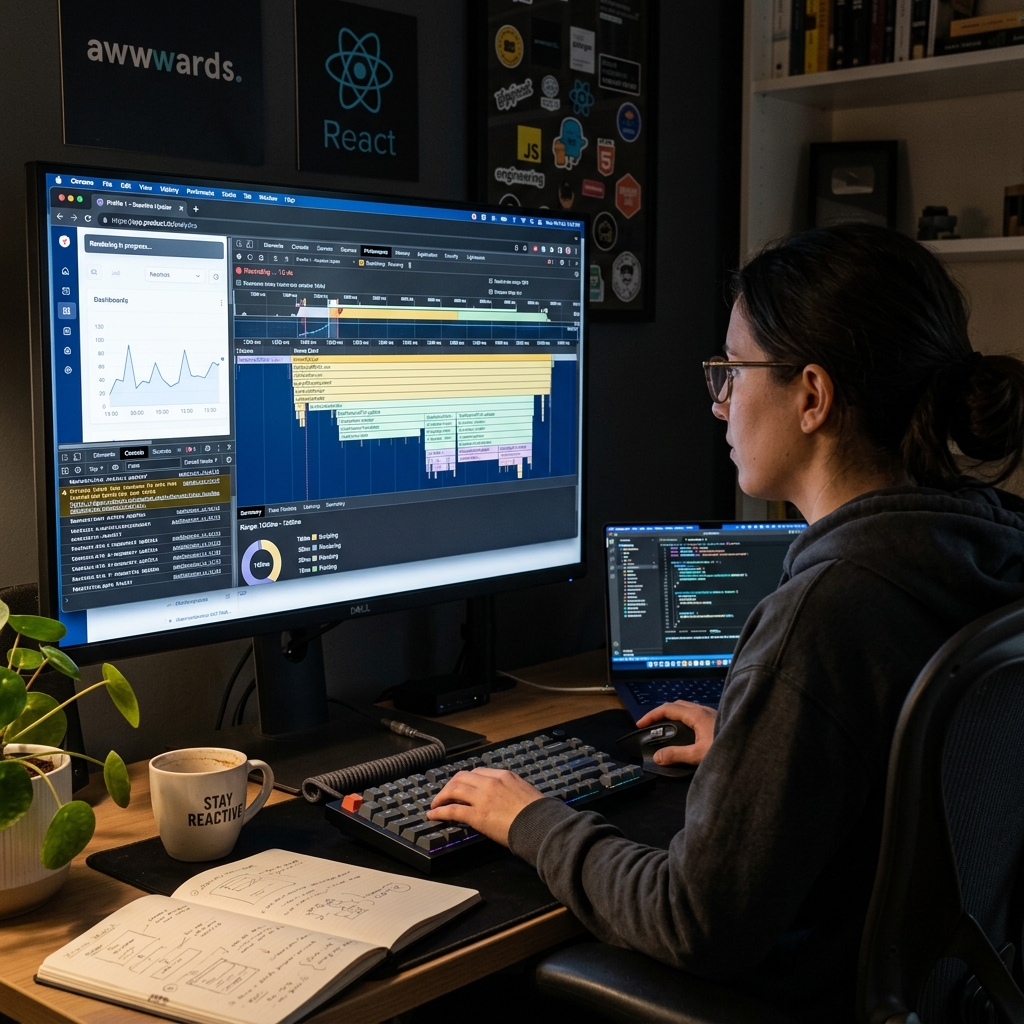
The new Angular DevTools inspector allows developers to visualize the Signal dependency graph and track state mutations in real-time.
Best Practices for Performance
To ensure you are getting the absolute maximum performance out of Signals, adhere to these rules:
- Keep computations pure: A
computedfunction must never have side effects. It should only read signals and return a value. - Avoid deep object mutation: Signals check for equality by reference (by default). If you mutate an object inside a signal without changing its reference (e.g.,
this.mySignal().push(newItem)), dependents won't update. Always update immutably:this.mySignal.update(arr => [...arr, newItem]). - Use granular signals for high-frequency updates: If you have an object with 50 properties, but only
xandycoordinates update at 60fps, extractxandyinto their own signals rather than updating the entire large object repeatedly. - Leverage Zoneless Angular: Angular 19 allows you to bootstrap applications entirely without Zone.js. By relying exclusively on Signals for state, you can remove the
zone.jspolyfill, reducing your bundle size and eliminating the overhead of global event patching.
Looking Forward: The Generative UI Era
As we build more AI-driven, agentic applications, the UI needs to be increasingly dynamic. Signals provide the perfect foundation for Generative UI architectures. When an LLM streams back structured data representing a component's state, updating a Signal immediately and deterministically reflects that change in the DOM.
Unlike virtual DOM diffing mechanisms which can struggle with rapid, massive state patches during a stream, Angular's fine-grained reactivity pinpoints the exact text node or binding that needs to change, making it incredibly resilient for complex, real-time AI interfaces.
Conclusion
Angular Signals represent the most significant architectural evolution since the transition from AngularJS to Angular 2. They offer a simpler mental model for state management, inherently superior performance, and a clear path toward a zoneless future. By understanding the core primitives, adopting state service patterns, and knowing when to blend Signals with RxJS, development teams can build enterprise-grade applications that are faster to develop, easier to maintain, and blisteringly fast for the end user.
Related
Resources
MCP Architecture Explained: Hosts, Clients, Servers & Data Flow
What Is MCP (Model Context Protocol)? A Complete Guide (2026)

OpenRouter API Tutorial: How to Connect & Fetch LLM Responses (JS/Node.js)
The Best AI Tools for Developers in 2026