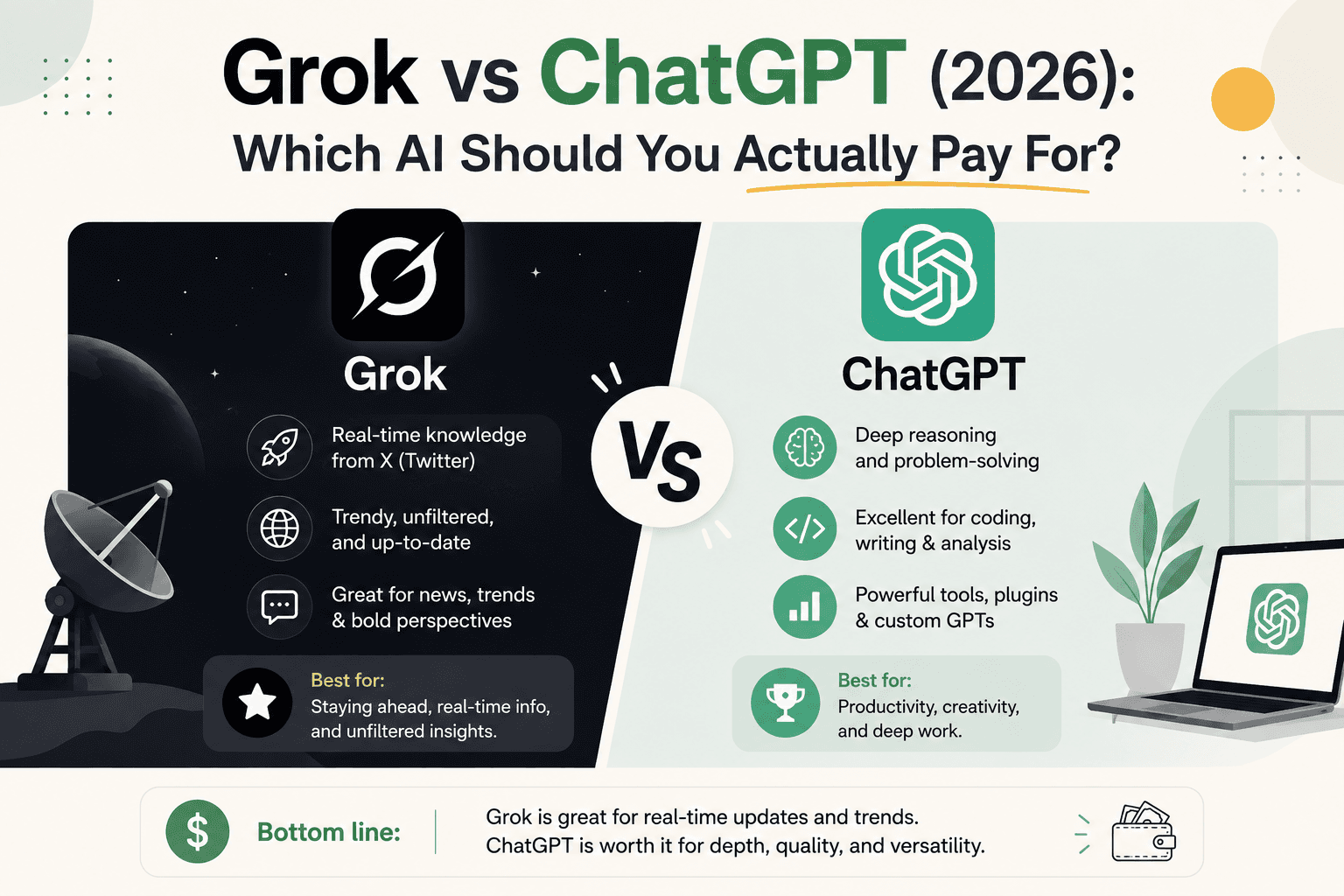
Grok vs ChatGPT (2026): Which AI Should You Actually Pay For?
Grok vs ChatGPT compared for 2026 — pricing, video generation, real-time data access, and coding. Includes a direct answer on whether Grok actually generates video.
Grok vs ChatGPT: which one actually deserves your $20 (or $30) a month?
Quick Answer
Grok, made by Elon Musk's xAI, is built around real-time X (Twitter) data access, built-in image and video generation through Grok Imagine, and a subscription structure that's genuinely confusing — seven overlapping tiers split across grok.com and X itself. ChatGPT, from OpenAI, remains the more polished, broader consumer product, with a bigger ecosystem, more consistent pricing, and generally stronger coding and long-context performance. Yes, Grok generates video — that's covered in detail below. For most people, ChatGPT is still the safer default; Grok earns a real look if you specifically want real-time social-data access or built-in video generation without paying for a separate tool.
What is Grok, and why is it different from ChatGPT?
Grok is xAI's AI assistant, built by Elon Musk's company and tightly integrated with X, the social platform Musk also owns. That integration is Grok's defining feature: it can pull real-time posts, trending topics, and sentiment data directly from X through a research mode called DeepSearch, something neither ChatGPT nor most other assistants can do natively at the same depth.
xAI iterates on Grok's underlying models fast — arguably faster than any other major lab. Grok 4 launched in July 2025; by mid-2026 the lineup had moved through 4.1, 4.3, and 4.5, with 4.6 rolling out shortly after and a further update reportedly expected within weeks of this writing. If you read a Grok comparison that cites a specific model number, assume it's already one or two versions behind by the time you're reading it — that's simply how fast this particular product moves.
What is ChatGPT, briefly
ChatGPT is OpenAI's assistant, and by mid-2026 it's the most widely used consumer AI product in the world, having crossed 1 billion users in July. It runs on the GPT-5.6 model family, with native image generation, Sora-powered video, voice mode, and a mature ecosystem including Codex for coding and the GPT Store for third-party integrations. Where Grok iterates its core model rapidly, ChatGPT has iterated more on its pricing structure and feature set — Plus, two separate Pro tiers, and Business/Enterprise plans, which we've broken down in detail in ChatGPT Plus vs Pro.
Grok vs ChatGPT: comparison table
| Grok (xAI) | ChatGPT (OpenAI) | |
|---|---|---|
| Current flagship model | Grok 4.5 / 4.6 (iterates very fast) | GPT-5.6 Sol |
| Real-time social/web data | Yes, native — DeepSearch pulls live from X | Web search available, not natively tied to a social platform |
| Native image generation | Yes, via Grok Imagine | Yes, native |
| Native video generation | Yes, via Grok Imagine (Aurora model) | Yes, via Sora |
| Free tier | Yes, rate-limited (~10 requests/2 hours) | Yes, with rolling limits |
| Entry paid tier | X Premium $8/mo or SuperGrok Lite $10/mo | Plus, $20/month |
| Full-featured individual tier | SuperGrok, $30/month | Plus covers most features; Pro tiers add more headroom |
| Top individual tier | SuperGrok Heavy, $300/month | Pro, $100–$200/month |
| Coding tool | Grok Build (in beta) | Codex |
| API pricing (per 1M tokens, in/out) | Roughly $2/$6 (current flagship) | GPT-5.6 Luna around $0.20 input after a mid-2026 price cut; higher for top-tier models |
| Known limitations | Reported to trail Claude on code quality and long-context recall above 128K tokens, and OpenAI on multi-turn function-calling reliability | Smaller real-time social-data access than Grok |
Note: Both companies change pricing and model names frequently — xAI in particular has retired and replaced entire model tiers more than once in 2026. Treat this table as an August 2026 snapshot and check grok.com/pricing and openai.com/chatgpt/pricing directly before subscribing.
Does Grok AI generate videos? (2026 update)
Yes. Grok generates video through a feature called Grok Imagine, powered by xAI's Aurora model. It launched in July 2025 and reached version 1.0 in February 2026, supporting both text-to-video and image-to-video generation with synchronized native audio. Output currently tops out at roughly 10 seconds of footage at 720p resolution.
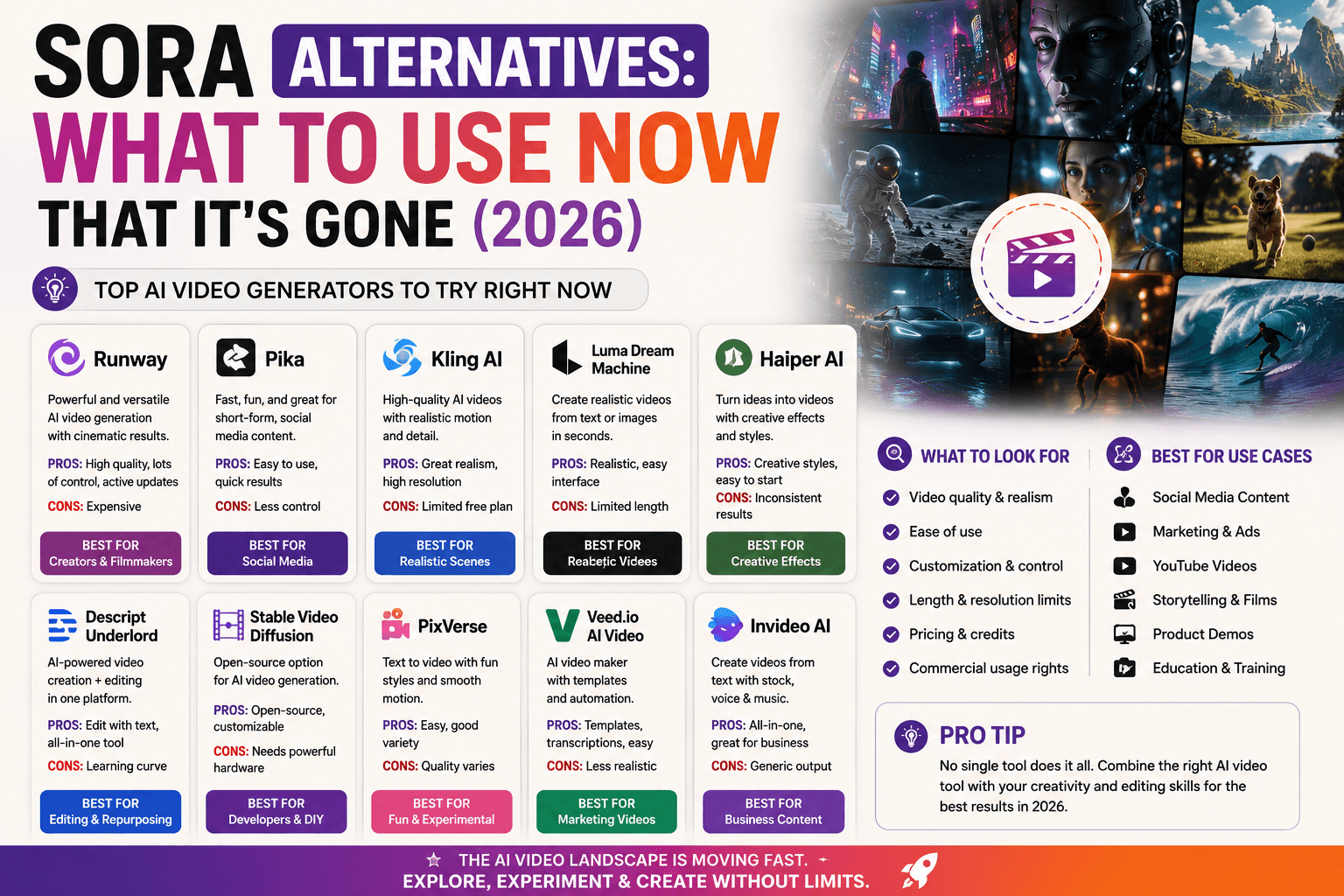
Video generation isn't available on Grok's free tier — it requires a paid plan. SuperGrok Lite ($10/month) unlocks a lighter version capped at 480p resolution and 6-second clips, while the full SuperGrok plan ($30/month) unlocks higher-quality, longer generation. Compared to ChatGPT's Sora, Grok Imagine is positioned as a faster, more casual tool tightly integrated with the X platform, rather than a standalone, production-oriented video generator — if cinematic quality or longer output is the priority, Sora on ChatGPT's higher tiers currently has the edge; if quick, social-ready clips generated without leaving the same app you chat in is what you want, Grok Imagine covers that well.
Key differences that actually matter
Real-time data access. This is Grok's clearest structural advantage. DeepSearch pulls live posts and trending data directly from X, which makes Grok noticeably stronger for questions about what's happening right now on social media specifically — sentiment tracking, breaking reactions, trend analysis. ChatGPT's web search is capable but isn't built around a single live social feed the way Grok's is.
Pricing structure. ChatGPT's pricing, while it's changed a lot in 2026, is at least a single, coherent ladder: Free → Go → Plus → Pro (two tiers) → Business → Enterprise. Grok's pricing is genuinely more confusing — it's sold across two separate storefronts (grok.com's SuperGrok tiers and X's Premium tiers), with seven overlapping options between them as of mid-2026. If pricing clarity matters to you, that's worth weighing on its own.
Coding. Independent reports through 2026 have generally placed Grok behind Claude specifically on code generation quality and behind OpenAI on multi-turn function-calling reliability in agentic loops — Grok Build, its dedicated coding tool, remains in beta. ChatGPT's Codex is a more mature, established option if coding is a core use case. For a deeper look at how the major coding-specific tools compare, see our Claude Code vs Cursor and Claude Code vs GitHub Copilot breakdowns.
Content moderation approach. xAI has publicly positioned Grok as less restrictive than competitors on certain topics, which has drawn both praise from users who find other assistants overly cautious and criticism following specific incidents where reduced filtering produced harmful output. This is a genuine philosophical difference between the two companies worth being aware of, even if it's not something a features table can fully capture.
Model iteration speed. xAI ships new model versions unusually fast — the jump from Grok 4 to 4.6 took well under a year. That speed is a genuine strength for staying near the frontier, but it also means specific benchmark claims and version numbers go stale faster for Grok than for almost any other major assistant.
Ecosystem and platform lock-in. ChatGPT is a standalone product you can use with no relationship to any other service. Grok's deepest value — DeepSearch, the tightest X integration, the X Premium+ bundle — is meaningfully better if you're already an active X user; if you're not on the platform at all, some of Grok's differentiation narrows, since you're paying for real-time access to a social feed you don't otherwise use. Worth factoring in before assuming Grok's real-time edge applies equally to everyone.
Grok vs ChatGPT: pricing
Grok's pricing, laid out clearly:
- Free — rate-limited (roughly 10 requests every 2 hours), basic Grok Imagine image generation
- X Premium — $8/month, bundles some Grok access with X platform perks
- SuperGrok Lite — $10/month, adds lighter Grok Imagine (images and 480p/6-second video), 2x the free tier's chat limits, one AI agent
- SuperGrok — $30/month, the mainstream tier: full model access, DeepSearch, Big Brain (extended reasoning) mode, full Grok Imagine, multiple parallel agents
- X Premium+ — $40/month, bundles full Grok access with ad-free X browsing and higher throughput
- SuperGrok Heavy — $300/month, the top individual tier
ChatGPT's pricing, for comparison:
- Free — rolling usage limits, some ads in certain regions
- Go — ~$8/month, higher limits than Free
- Plus — $20/month, the full consumer feature set: Deep Research, Sora video, Codex, Agent Mode
- Pro — $100 or $200/month across two tiers, for heavy usage (full breakdown in ChatGPT Plus vs Pro)
Which gives better value? At the entry level, Grok's cheapest meaningful paid tier (SuperGrok Lite, $10) undercuts ChatGPT Plus ($20) on price, but with real feature gaps — limited video resolution, fewer agent slots. For a full-featured individual plan, SuperGrok at $30/month costs 50% more than ChatGPT Plus while offering a narrower overall feature set (no dedicated equivalent to Deep Research's depth, a beta-stage coding tool). ChatGPT Plus is generally the better single subscription for most people; Grok's value case strengthens specifically if real-time X data or quick video generation are core to what you need.
Hands-on impressions
Running the same set of tasks through both — a mix of general questions, a coding request, and a request for a short video clip — surfaced a pattern that matched the feature comparison closely.
For a question about how a specific topic was trending on social media that day, Grok's answer was noticeably more current and specific, pulling in actual recent post activity in a way ChatGPT's web search didn't quite match — this is the one category where reaching for Grok felt like the obviously correct choice rather than a coin flip.
For a coding task — fixing a bug in a small script — ChatGPT's answer needed less back-and-forth to get right, and Codex handled a follow-up refactor more cleanly than Grok Build managed with the same request. This lined up with what independent reports suggested going in, though it was still worth confirming firsthand rather than taking it on faith.
For video, Grok Imagine's output arrived faster than expected and was genuinely fun to iterate on for a quick, casual clip — but the 10-second cap and visible quality gap compared to Sora's output on ChatGPT's higher tiers were both noticeable the moment quality actually mattered rather than just novelty.
Bottom line from testing: Grok earned its keep specifically on real-time, X-native questions and quick casual video generation. For coding, general reasoning, and anything where output quality needed to be production-ready rather than "good enough for a quick post," ChatGPT was the tool reached for by default. One smaller thing worth mentioning: navigating which Grok tier actually unlocked which feature took noticeably longer than figuring out ChatGPT's plans, simply because Grok's seven overlapping tiers across two storefronts took a genuine sit-down-and-read-carefully effort the first time, in a way ChatGPT's more linear Free-to-Pro ladder didn't.
Who should choose which
- Choose ChatGPT if: you want the more complete, polished all-around assistant, better coding support, higher-quality video generation, and a pricing structure that's easier to understand at a glance.
- Choose Grok if: real-time X/social data access is a regular part of your work, you want casual video generation without leaving the same app, or you specifically want a less restrictive content-moderation stance.
- Consider both if: you're active on X and want Grok's real-time edge for that specific use case, while keeping ChatGPT (or another assistant) as your daily driver for everything else — a common enough pattern that it's worth mentioning rather than treating this as a strict either/or.
FAQ
Is Grok better than ChatGPT? Not universally — Grok has a clear edge on real-time X/social data access and casual video generation baked into the same app. ChatGPT is generally stronger on coding, output polish, and has a more coherent pricing structure. The right pick depends on which of those matters more to you.
Does Grok AI generate videos? Yes, through a feature called Grok Imagine, powered by xAI's Aurora model. It supports text-to-video and image-to-video with synchronized audio, capped at roughly 10 seconds and 720p resolution, and requires a paid SuperGrok or SuperGrok Lite subscription.
Is Grok cheaper than ChatGPT? At the entry level, yes — SuperGrok Lite at $10/month undercuts ChatGPT Plus at $20/month, though with real feature limitations. At the mainstream tier, SuperGrok ($30/month) actually costs more than ChatGPT Plus while offering a narrower feature set overall.
Is Grok good for coding? It's usable but generally reported as behind both Claude and ChatGPT's Codex on code generation quality and multi-turn reliability. Grok Build, xAI's dedicated coding tool, remains in beta as of this writing.
What's the difference between SuperGrok and X Premium+? SuperGrok ($30/month) is a standalone AI subscription focused entirely on Grok's capabilities. X Premium+ ($40/month) bundles similar Grok access with X platform perks like ad-free browsing and a verified badge — worth it only if you also want the social platform benefits.
Why does Grok have so many pricing tiers? Grok is sold through two separate storefronts — grok.com (SuperGrok tiers) and X itself (Premium tiers) — which has led to seven overlapping plans as of mid-2026. It's more confusing than ChatGPT's single pricing ladder, and worth reading carefully before subscribing.
How current is Grok's real-time data, really? Very — DeepSearch pulls directly from X's live post stream, which is a genuine structural advantage for anything tied to current social sentiment or breaking discussion. It's less of an advantage for general knowledge questions unrelated to what's trending on the platform right now.
Do I need an X account to use Grok? No, SuperGrok is available as a standalone subscription through grok.com without an X account. That said, Grok's deepest real-time features are most useful to people already active on X — without that context, some of its differentiation from ChatGPT narrows.
Which is better for a business or team, Grok or ChatGPT? ChatGPT, for most teams — it has a more mature Business/Enterprise tier structure, broader third-party integrations, and a more established coding tool in Codex. Grok's business-focused options are less developed as of this writing, and its confusing consumer pricing structure doesn't map as cleanly onto team billing.
Conclusion
Grok and ChatGPT aren't really competing to be the same product, even though they get compared constantly. Grok's identity is tied directly to X — real-time social data, fast model iteration, and casual creative tools baked into one app. ChatGPT's identity is being the broadest, most polished general-purpose assistant available, with stronger coding support and a pricing structure that, whatever its flaws, is at least easier to follow than Grok's seven-tier split across two storefronts. For most people asking general questions, writing, or coding, ChatGPT remains the safer default in 2026. If your work or interests genuinely intersect with real-time social data or you want quick video generation without a separate tool, Grok has earned a real place on the shortlist — just go in knowing exactly which tier you're actually paying for.
Related
Resources
Claude Pro vs Max: Which Plan Actually Pays for Itself in 2026?

Best AI Video Generator in 2026: 15 Tools Compared (Free & Paid)
How to Upgrade Claude Pro to Max (2026): Step-by-Step Guide
Sora Alternatives: What to Use Now That It's Gone (2026)