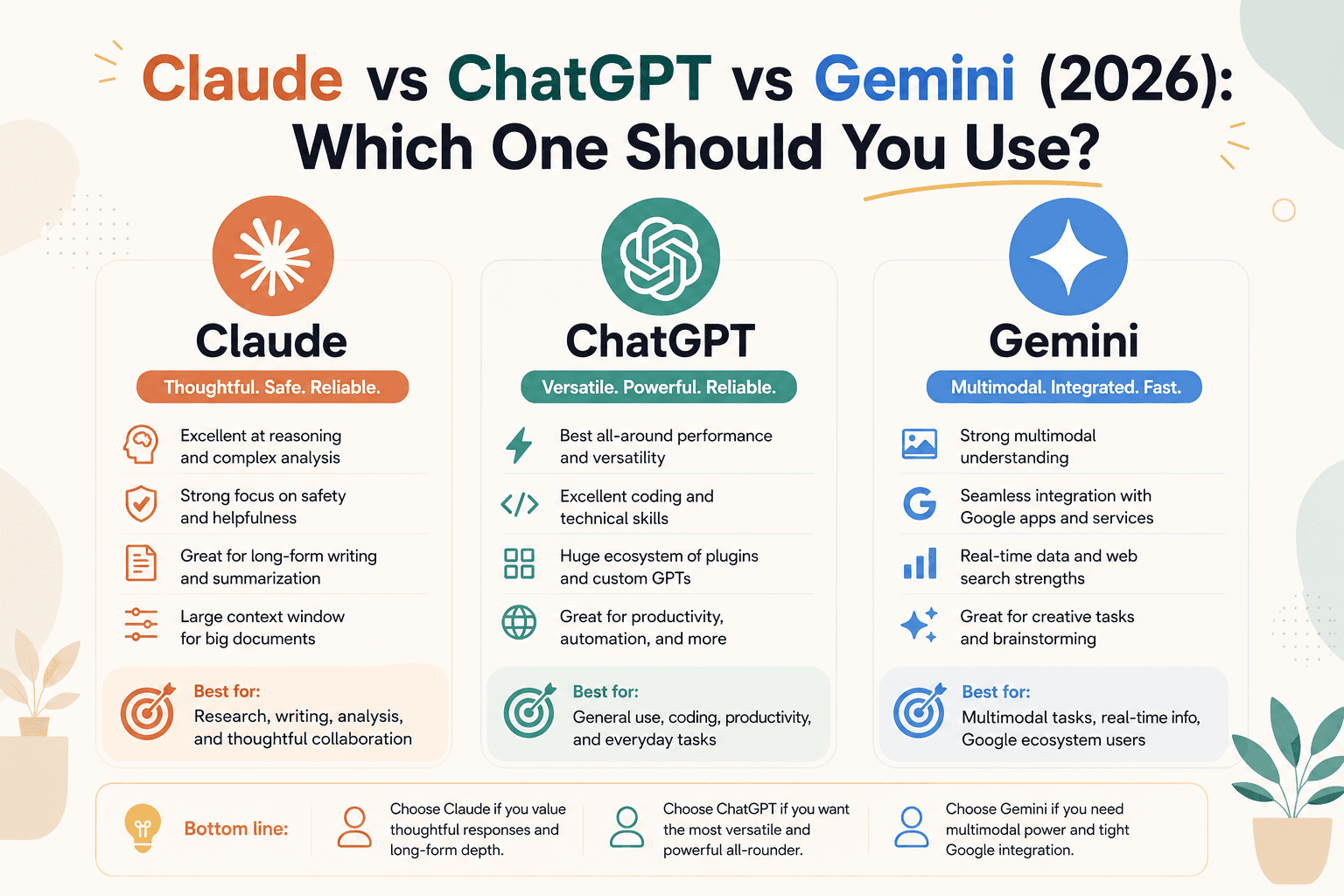
Claude vs ChatGPT vs Gemini (2026): Which One Should You Use?
Claude vs ChatGPT vs Gemini compared side by side — pricing, coding, writing, multimodal tools, and which one actually fits your workflow, with links to full head-to-head breakdowns.
Claude vs ChatGPT vs Gemini: which one should you actually be paying for?
Quick Answer
Claude tends to win on writing quality and coding depth through Claude Code. ChatGPT wins on multimodal breadth — native image, voice, and video generation plus the largest plugin ecosystem — in one subscription. Gemini wins on native Google Workspace integration and multimodal generation at a lower effective cost, especially if you already pay for Google storage. All three cost roughly $20/month at the entry paid tier, so the decision usually comes down to which specific list of strengths matches your actual week, not price. A growing number of professionals just run two or three of them side by side.
The three, in one paragraph each
Claude, from Anthropic, is built around careful reasoning and writing quality. The current lineup runs from Haiku 4.5 (fast, cheap) through Sonnet 5 (the balanced default) up to Opus 5 (the flagship, released July 2026) and Fable 5, a newer top-tier model in Anthropic's "Mythos" class. Claude Code is Anthropic's dedicated agentic coding tool, and it's the single biggest reason developers pick Claude over the other two. What Claude doesn't do: generate images or video natively, at all.
ChatGPT, from OpenAI, is the broadest generalist of the three. It launched publicly in November 2022 and has since folded in native image generation, a full voice-conversation mode, Sora-powered video generation, and Codex for coding — all inside one product. Pricing now spans Free, Go (~$8/month), Plus ($20/month), and two separate Pro tiers ($100 and $200/month), reflecting how aggressively OpenAI has expanded the lineup through 2026.
Gemini, from Google DeepMind, leans hardest into native multimodality and ecosystem integration. Gemini 3.1 Pro remains the flagship reasoning model as of this writing — notably, Google's promised successor, Gemini 3.5 Pro, has missed three separate launch targets since May 2026 — while the Flash tier (3.6 Flash, 3.5 Flash-Lite) has shipped updates far more frequently. Gemini's biggest practical advantage is depth of integration with Gmail, Docs, Sheets, and Drive, plus built-in image (Imagen) and video (Veo) generation.
Claude vs ChatGPT vs Gemini: comparison table
| Claude | ChatGPT | Gemini | |
|---|---|---|---|
| Maker | Anthropic | OpenAI | Google DeepMind |
| Current flagship | Opus 5 / Fable 5 (Mythos tier) | GPT-5.6 Sol | Gemini 3.1 Pro |
| Fast/cheap tier | Haiku 4.5 | Go (~$8/month) | Gemini 3.6 Flash |
| Free plan | Yes, with daily caps | Yes, with ads in some regions | Yes |
| Entry paid plan | Pro, $20/month | Plus, $20/month | Google AI Pro, ~$20/month (bundles 2TB storage) |
| Top individual plan | Max, $100–$200/month | Pro, $100–$200/month | Google AI Ultra, ~$250/month |
| Native image generation | No | Yes | Yes |
| Native video generation | No | Yes (Sora) | Yes (Veo) |
| Coding agent | Claude Code | Codex | IDE integrations, Antigravity |
| Deep research mode | Yes | Yes | Yes |
| Context window (top tier) | 1M tokens | Standard (1M is a $200-Pro-only feature) | 1M tokens (2M rumored for the delayed 3.5 Pro) |
| Ecosystem integration | MCP connectors (Drive, Slack, GitHub) | GPT Store, Microsoft Copilot | Native Gmail, Docs, Sheets, Drive |
| Known for | Writing quality, reasoning, coding depth | Multimodal breadth, ecosystem size | Multimodal generation, Workspace integration |
Note: All three companies change pricing, model names, and usage limits frequently — OpenAI alone has adjusted ChatGPT's lineup roughly fifteen times over the twelve months to mid-2026. Treat this table as an August 2026 snapshot and confirm current details directly with each provider before subscribing.
Where each one actually wins
Spread across enough tasks, a fairly consistent pattern shows up:
- Coding, especially agentic or multi-file work: Claude, largely on the strength of Claude Code. Independent benchmark trackers have consistently placed Claude's top-tier models at or near the top of agentic coding indexes through 2026.
- Long-form writing and editing: Claude again, generally cited for prose that needs less editing to sound natural, with fewer generic transitions than either competitor's default output.
- Multimodal generation (image, voice, video) in one place: ChatGPT, with the broadest single-product toolkit of the three.
- Cost-effective multimodal work and long documents: Gemini, particularly if Google's storage bundle already offsets part of the subscription cost.
- Ecosystem and integration depth: a genuine split — ChatGPT if your world runs through the GPT Store or Microsoft tools, Gemini if it runs through Gmail, Docs, and Sheets.
- Research that needs to land in a shareable document: Gemini, since Deep Research output plugs directly into Docs; Claude and ChatGPT both require an extra export step.
Which one should you use, by job
- You're a developer, especially doing multi-file or agentic work: Claude, via Claude Code.
- You write for a living — content, marketing, fiction: Claude, for drafting; either of the other two work fine for editing.
- You need image or video generation without switching tools: ChatGPT or Gemini — Claude isn't in this race at all.
- You already live inside Google Workspace: Gemini removes real friction the other two can't match.
- You want the single largest ecosystem of plugins and integrations: ChatGPT's GPT Store and Microsoft Copilot reach give it the edge.
- You're budget-conscious and process a lot of tokens via API: Gemini is generally the cheapest per-token option of the three.
- You genuinely don't know yet: all three have usable free tiers — running the same real task through each for a week beats reading any comparison, including this one.
Can you reasonably run all three?
Yes, and it's more common than the "pick a winner" framing of most comparisons suggests. At roughly $20/month each for the entry tier, running all three costs about the same as one premium subscription to any single provider's top individual plan — while covering meaningfully more ground than one tool alone. A pattern that comes up often among people who do serious work across categories: Claude for coding and drafting, ChatGPT for anything that needs an image or a quick voice interaction, Gemini for research that needs to land in a Doc or for parsing something genuinely long. None of the three is being asked to be everything at once, which tends to produce better results than forcing one tool to cover all of it.
Want the deeper head-to-head? Three dedicated breakdowns
This article is deliberately the broad overview — for anyone who's already narrowed the field to two of the three, each pairing gets a full, dedicated comparison elsewhere on the site:
- Leaning toward Claude or ChatGPT specifically? Claude vs ChatGPT goes deep on writing quality, Claude Code vs. Codex, and the safety-philosophy differences between the two companies.
- Leaning toward Claude or Gemini specifically? Claude vs Gemini covers the full current model lineup on both sides, including Gemini 3.5 Pro's repeated launch delays and how that's affected the comparison through mid-2026.
- Leaning toward ChatGPT or Gemini specifically? Gemini vs ChatGPT breaks down the two most feature-comparable products of the three, including where their multimodal tools actually diverge.
Hands-on experience: running real work through all three
I've kept active subscriptions to all three at once for long enough now that switching between them has stopped feeling deliberate — it's closer to reaching for whichever one is already open. That habit itself turned out to be the most useful data point for writing this: I never consciously decided "I'll use Gemini for this," I just noticed, afterward, which one I'd actually reached for.
For a longer piece of writing this month — a client report that needed a specific, consistent voice — I opened Claude without really thinking about it, the same way I'd have grabbed a specific pen out of a drawer. The draft needed noticeably less rewriting to sound like something I'd actually written myself, which matched what the comparison data suggested going in, but living it felt more convincing than reading it.
For a task that needed a supporting product mockup image, I didn't even consider Claude — the decision was already made before I opened anything, purely because I know it isn't an option. ChatGPT and Gemini both produced usable results; Gemini's came in slightly faster and I didn't have to leave the same window I was already researching in, which mattered more in the moment than I expected it to.
For a research task pulling together competitor pricing across a handful of sources, Gemini's Deep Research output landed directly in a Doc I could immediately share, which saved a step I'd have had to do manually with either of the other two. Claude's version of the same research read better as a standalone document — better structured, more clearly the finished thing rather than a first draft — but I still had to copy it somewhere before anyone else could see it.
None of these were close calls in the moment, which was the most useful thing I took away from actually testing this rather than just reading about it: the "which one is best" framing mostly dissolves once you're doing real work, and what's left is closer to muscle memory about which tool already solves the specific problem in front of you.
FAQ
Which is better, Claude, ChatGPT, or Gemini? None is universally better — each is built around a different core strength. Claude tends to lead on writing and coding, ChatGPT on multimodal breadth and ecosystem size, and Gemini on Workspace integration and cost-effective multimodal generation. The right pick depends on which of those matches your actual work.
Which is the best AI for coding? Claude, largely due to Claude Code, is the most commonly recommended for agentic and multi-file coding work based on independent benchmarks through 2026. ChatGPT's Codex and Gemini's IDE integrations are both capable but less frequently cited as the top pick for autonomous, multi-step coding specifically.
Which is the cheapest of the three? Entry-level pricing is close across all three, around $20/month (Claude Pro, ChatGPT Plus, Google AI Pro). Gemini's plan bundles 2TB of Google One storage, which can lower its effective cost if you're already paying for that storage separately.
Can Claude generate images like ChatGPT and Gemini? No. Claude does not generate images or video at all — this is the clearest, least ambiguous difference among the three. Both ChatGPT (via native image tools and Sora) and Gemini (via Imagen and Veo) handle this natively.
Do I need to pick just one? No. Running two or three at roughly $20/month each is a common setup for anyone whose work spans multiple categories — coding, writing, research, and visual content rarely all get served best by a single tool.
Which one has the largest context window? As of August 2026, Claude's and Gemini's top tiers both reach around 1M tokens; ChatGPT reserves its 1M-token window for the $200 Pro tier specifically. Gemini's delayed 3.5 Pro is rumored to reach 2M tokens, though that remains unconfirmed until it officially ships.
Is Gemini 3.5 Pro out yet? Not as of this writing. Google announced it in May 2026 and has missed three separate target launch dates since. The current Gemini flagship remains Gemini 3.1 Pro, from February 2026.
Conclusion
Comparing all three at once tends to produce a less satisfying answer than a head-to-head, and that's honestly the accurate one: there isn't a single winner among Claude, ChatGPT, and Gemini, because they weren't built to compete on the same axis. Claude concentrates its effort into writing and coding depth. ChatGPT spreads its effort across the widest multimodal toolkit in one place. Gemini leans into ecosystem integration and cost-effective generation. If you can only justify one subscription, match it to the single task you do most often — not a features list. If your work genuinely spans categories, running more than one is a common, practical answer, and for a deeper look at any specific pairing, the dedicated comparisons linked above go considerably further than this overview does.
Related
Resources
Claude Pro vs Max: Which Plan Actually Pays for Itself in 2026?

Best AI Video Generator in 2026: 15 Tools Compared (Free & Paid)
How to Upgrade Claude Pro to Max (2026): Step-by-Step Guide

Sora Alternatives: What to Use Now That It's Gone (2026)